
John G Murdoch: A Numismatic Provenance of Biblical Proportions
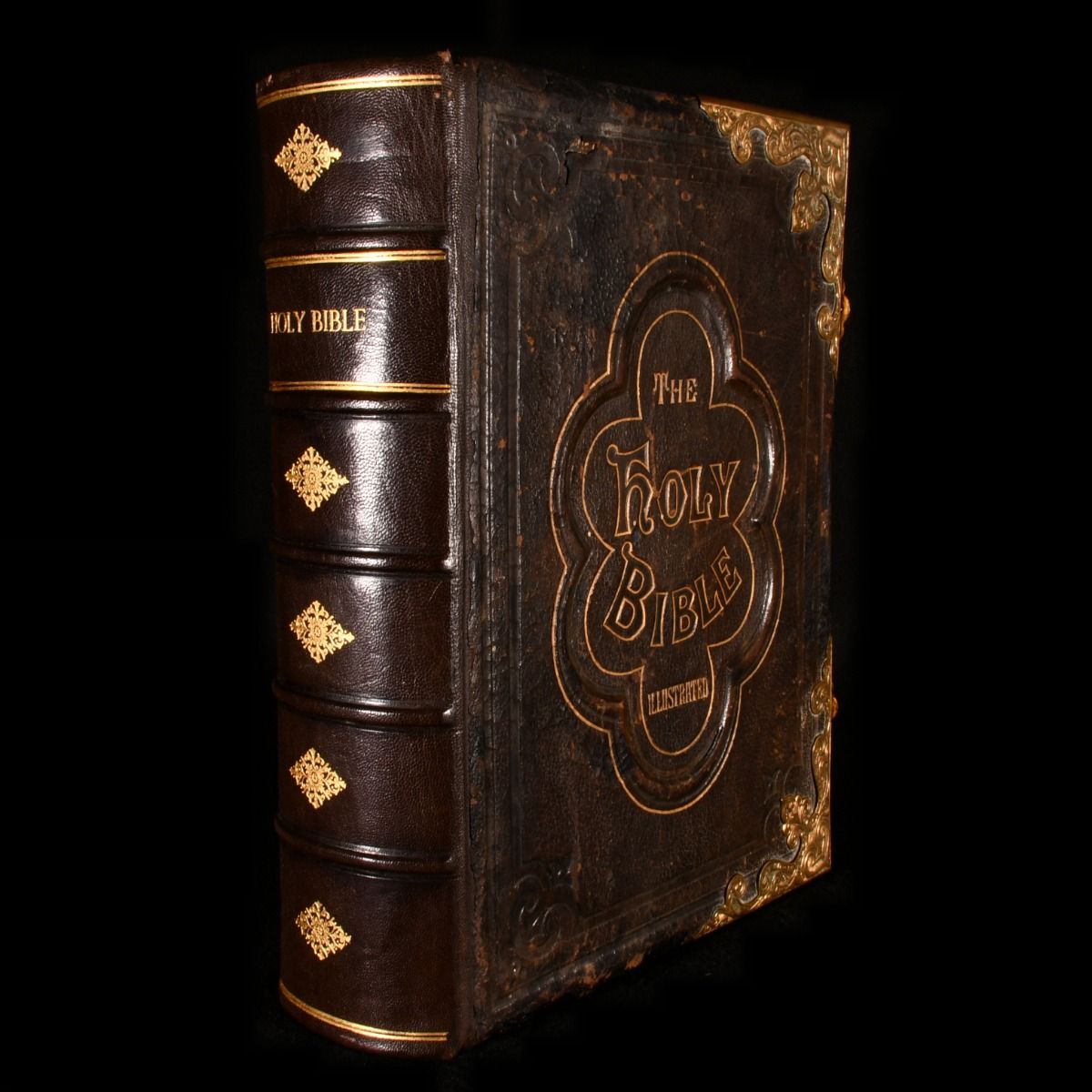
Bible by John G Murdoch
Image Source: Rooke Books
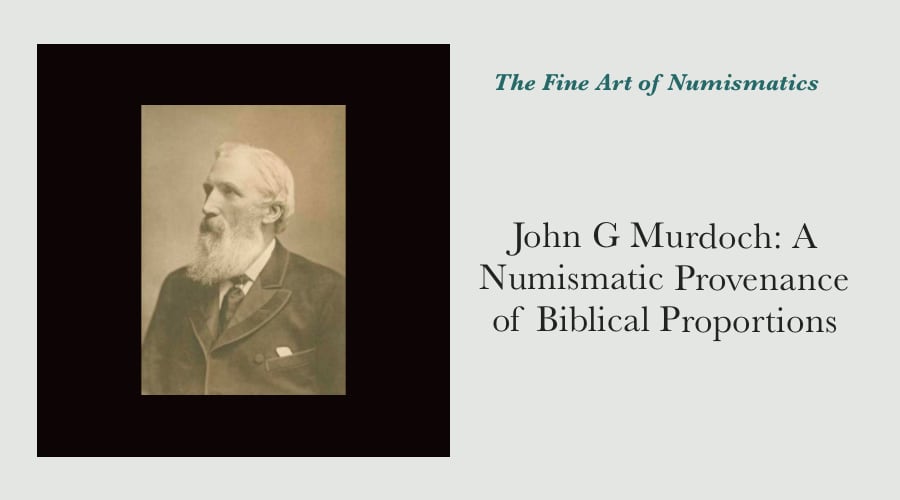
John G Murdoch was one of Britain’s leading coin collectors. Murdoch’s business was in publishing Bibles and manufacturing musical boxes. Before you disregard these enterprises as more curious than mainstream, you should be aware that the Bible publishing business in Britain during the late 1800s was a prolific and highly lucrative industry. Bibles were regarded as essential household items in Victorian Britain - they were in virtually every British home, and they served as both religious texts and as decorative furniture. Murdoch’s lavishly illustrated, leather-bound, and gilt Bibles sold for more than a week’s wages, and he regularly sold more than 30,000 copies a year.
By the 1880s, Murdoch had successfully transitioned his “biblical wealth” into John G. Murdoch & Co. Ltd, which became one of the largest musical instrument retailers and manufacturers in the UK. Even after he moved away from Bibles, the "Murdoch" name remained synonymous with quality in both British households and the colonies.
In an article published in the Journal of the British Numismatic Society on Murdoch and his collection, Lord Stewartby advised that Murdoch “…had joined the Numismatic Society of London (as it then was) in 1885, and he does not appear to have been collecting much earlier than that since most of the sales from which his coins were obtained took place after that date.” On a list of members of the Numismatic Society of London, John G Murdoch is listed as having died on July 22nd, 1902.
“The Most Important Numismatic Collection Ever Sold In This Country”
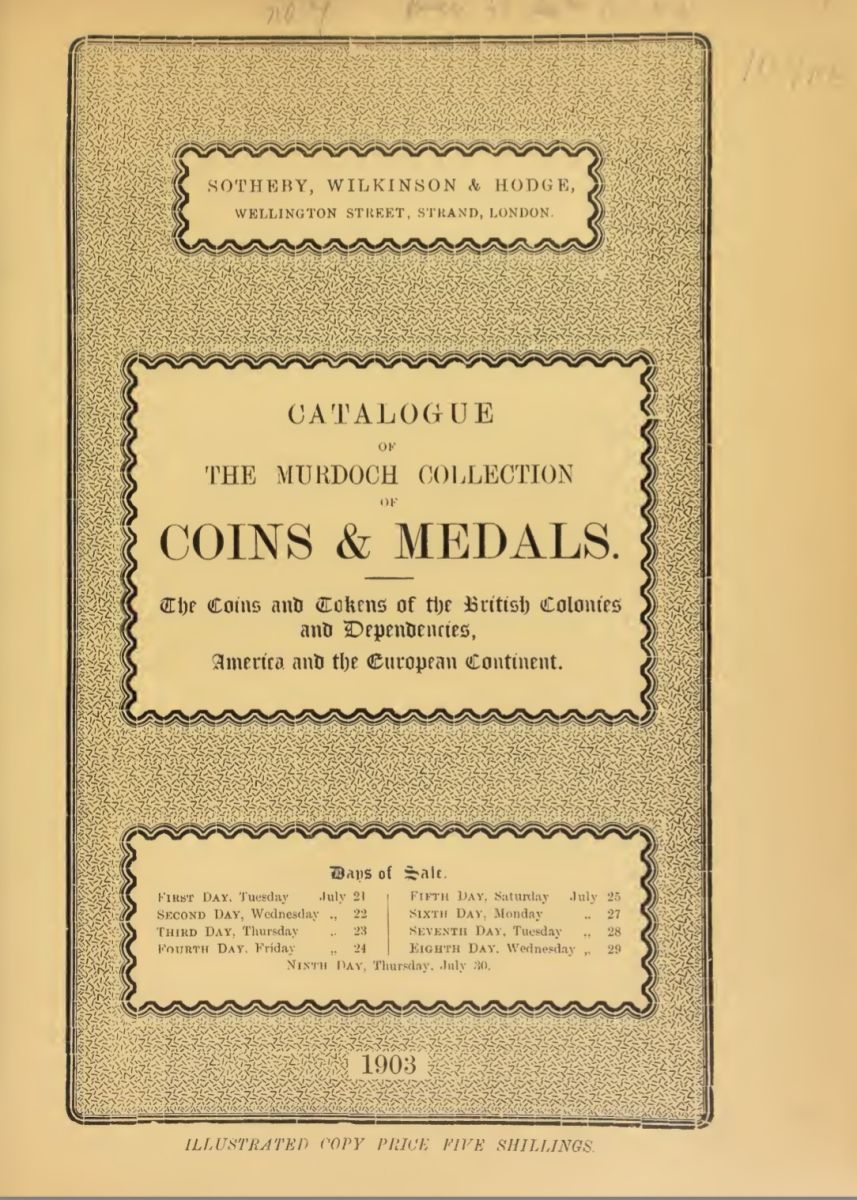
Inlay for Auction of John G Murdoch
Image Source: Sotheby, WIlkinson and Hodge
The preface to the catalogue prepared by Sotheby’s for the sale of Murdoch’s collection stated it was: “…second only to the late Mr Montagu's. The two collections are probably the most important, valuable and extensive ever formed in England. Mr Murdoch did not collect Greek and Roman coins. If these series are eliminated from the Montagu Collection, we think Mr Murdoch's will be found to be the most important numismatic collection ever sold in this country”.
The relevance of John G Murdoch to collectors of Australian gold coins lies in a request he made of the Melbourne Mint for proof coins “…in 1890…”, principally because nearly all of the proof gold coins struck by the Melbourne Mint that are available to collectors today can be traced back to this request and Murdoch’s collection.
Discussion of these gold coins from Murdoch’s collection has felt very similar to the discussion of the Sydney Mint patterns and proofs struck by the Melbourne Mint in February 1927. On face value, both situations appear to be unorthodox - wealthy private collectors were closely linked to the Royal Mint’s production of exclusive gold coins not available to the general public. Both situations, however were conducted with full knowledge of senior Mint staff, within Australia and London.
The generalisations around and superficial explorations of the circumstances of both situations has caused some collectors to shy away from the coins involved, principally out of a concern that information might come to light in future that could cause the rarity of the coins to be diminished.
A thorough review of the fulfilment of Murdoch’s request addresses any such concerns. If anything, it affirms just how rare these coins are and how compelling the Murdoch provenance is.
Proof Gold Coins Dating From the Establishment in 1871 to Murdoch’s request in 1890
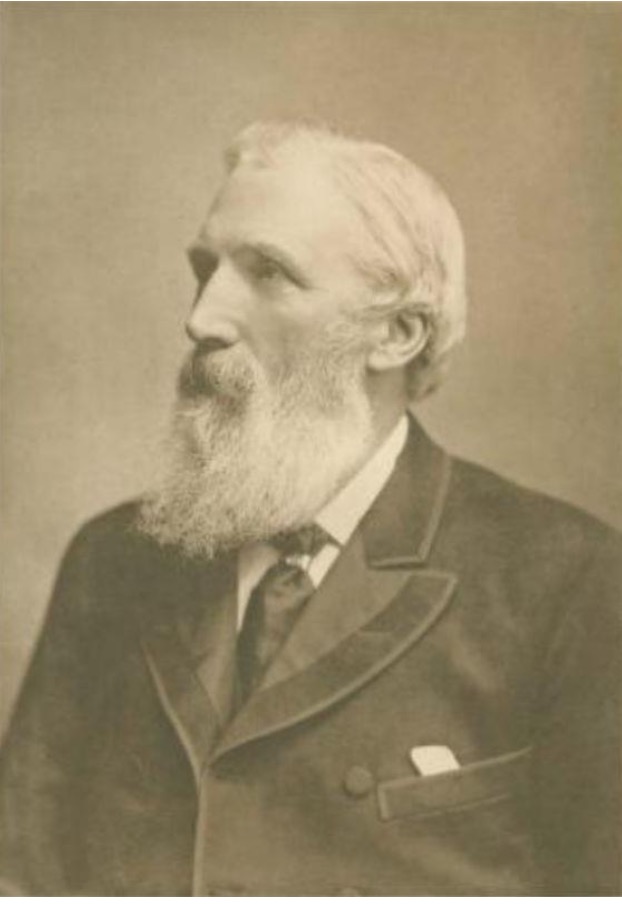
John G Murdoch
Image Source: Baldwin and Son
William (Bill) Mullet was a Senior Technical Officer at the Melbourne Mint at the time it ceased operations. Mullett was in charge of ensuring the Mint’s assets were transferred either to the Royal Australian Mint or the Melbourne Museum. Mullet reviewed the Melbourne Mint’s archival material extensively, he self-published his findings in several small publications in the 1990s.
Regarding the minting of proof gold coins at the Melbourne Mint, a list prepared by Mullet listing the years in which specimen gold coins were struck includes only two dates earlier than 1888 - 1884 and 1886.
1890 - 1893 Preparation for the Fulfilment of Murdoch’s Request
In his research covering the production of specimen (proof) gold coins by the Melbourne Mint, Bill Mullett lists only two dates earlier than 1888 - 1884 and 1886. Both Mullet and Sharples are clear that on May 10th 1893, staff at the Melbourne Mint struck 10 proof Jubilee Head Half Sovereigns for each of the following dates: 1888, 1889, 1890, 1891, 1892, and 1893.
Anyone who tracks the availability of proof gold coins is aware that the available population of these proof or specimen coins is much lower than those production figures might allow for. Mullet addresses that disparity by stating: “The number might have allowed for the rejection of half or more of those struck. The pieces with smoothed edges would be remelted if rejected, but those with the milled edge could have gone to circulation. If the blanks were heavily polished, they might have been too light for circulation. If so, and rejected, they would also be remelted.”
Mullet also states that milled edge proof sovereigns and Half Sovereigns with the Veiled Head dated 1893 were struck on April 20th 1893, and that on April 24th 1893, plain edge proof sovereigns and Half Sovereigns with the Jubilee Head dated 1889 were struck.
Melbourne Mint records indicate that in the years following 1893, proof gold coins dated 1894, 1895, 1896, 1897, 1898, 1899, 1900 and 1901 were also struck. It should be noted that proof gold coins from other dates to those listed above have appeared for sale on the open market, so Mullet’s list should not be taken as being definitive.
Queen Victoria died on January 22nd, 1901, while the coronation of King Edward VII took place on August 9th, 1902. On a list of members of the Numismatic Society of London, John G Murdoch is noted as having passed away on July 22nd, 1902.
The Melbourne Mint first struck Edward VII sovereigns for circulation on January 3rd 1902, and interestingly: “…30 specimen pieces sovereigns” dated 1902 were struck on January 8th 1902. The Melbourne Mint first struck Edward VII half sovereigns for circulation on May 30th 1902.
1902 to 1931 - From Murdoch’s Death to the end of Gold Coin Production
In his summary of yearly production for the years from 1903 through to 1931, Mullet makes no direct reference to specimen or proof gold coins being struck. It should be noted that proof gold coins from other dates to those listed above have appeared for sale on the open market, so again, Mullet’s list should not be taken as being definitive.
Even with that qualification in mind, if Mullet’s research indicated that the Melbourne Mint struck proof or specimen gold coins on only two occasions in the 19 years that passed between its establishment in 1871 and Murdoch’s request in 1890, and did not strike any more proof gold coins between the year of Murdoch’s death in 1902 and the end of gold coin production in 1931, the incredible influence of Murdoch’s request in 1890 becomes apparent.
The Dies Used to Strike Murdoch’s Proof Gold Coins

1890 Melbourne Jubilee Head Proof Half Sovereign
After learning of Murdoch’s special request of the Melbourne Mint, I wondered how Mint staff went about the task. Did they simply use previously-issued dies out of storage? Were any of those dies different to those used to strike circulating coinage? Was one common obverse die paired with each reverse of a different date?
Mintage figures for half sovereigns struck by the Melbourne Mint in the late 19th century indicate that the level of economic activity only required new injections of circulating gold coins once every few years. In the Jubilee Head era, Melbourne issued Half Sovereigns for circulation only in 1887 and 1893. [Interestingly, Mullet advises that in 1889 “£64,000 of half sovereigns were struck. These 128,000 pieces were at the rate of 225,000 per pair of dies, so 1 die was worn and 1 still good.” This date is not known as a circulating coin, which indicates Mullet’s observation needs verification.]
David Iverson and Steve Hill in the United Kingdom have conducted extensive research into the dies used to strike the Jubilee Head gold coinage, the result of which is the identification of numerous differences in the obverse and reverse dies used for certain dates, in certain years and at certain mints. The research by Iverson and Hill has determined that the main obverse variant for the 1887 Melbourne Jubilee Head Half Sovereign is the “hooked J” type, while the reverse is the “High Shield” type.
The research by Iverson and Hill has determined that the obverse for the 1893 Melbourne Jubilee Head Half Sovereign is the “Imperfect J” type, while the reverse is the “Low Shield” type. The obverse die used to strike the 1890 Melbourne proof Half Sovereign is the “Imperfect J type initials” type, while the reverse is the “Low Shield” type. With these technical characteristics in mind, it is interesting to compare the dies used with those used to strike the circulating Half Sovereigns struck during this period.
The high shield is the first reverse type seen on the Jubilee Head Half Sovereigns at the London Mint, as well as at the Sydney and Melbourne branches. London first used the low reverse in the production of Half Sovereigns in 1890, while the Sydney Mint first used the low shield reverse in 1889.

1889 Melbourne Jubilee Head Plain Edge Half Sovereign
Image Source: Museum Victoria
Mullet’s research on the annual production of gold coins at the Melbourne Mint includes references to Half Sovereign dies being received in 1889, 1890, 1891 and 1892. Although Mullet does not refer to Half Sovereign dies being received for 1888, the existence of several proof Half Sovereigns with that date clearly indicates they were in fact, received.
The Sharps Pixley collection of Australian gold coins held one of each of the Half Sovereigns struck by the Melbourne Mint for John G Murdoch, and was auctioned by Noble Numismatics in November 1989. Images in that catalogue show that the 1888 Melbourne was the “High Shield” reverse type, while each of the proofs dated between 1889 and 1892 were of the “Low Shield” reverse type.
The difference between the reverse die used for the 1888 Melbourne Half Sovereign and those dated from 1889 to 1892 indicates Melbourne Mint staff appear to have used the previously-issued die pairs they received for each year’s production to strike the proofs for Murdoch.
The 1890 Melbourne Proof Half Sovereign has several interesting artefacts, the first in the left obverse field between Victoria’s forehead and the right of the “I” in “VICTORIA”, the second around the larger pearl in Victoria's earring. Preliminary comparisons between the 1890 Melbourne Jubilee Head Proof Half Sovereign and the 1889 Melbourne Jubilee Head Half Sovereign with a plain edge (struck in April 1893) indicate that a common obverse was likely used to strike both coins. More research is needed to confirm this preliminary conclusion.
