
CoinSnap - A Fantastic App That's Not Fit for Purpose
Coinsnap Coin Identification App
Twice in the past week, I've gotten myself into trouble. Both of those times were with intelligent people I respected, folks who I wanted to do business with and who I wanted to help.
The trouble happened when a phone app called CoinSnap got mentioned and (both times) I inelegantly advised that I thought it was rubbish.
Now, nobody likes being told that the one tool they relied on to do their due diligence is crap, not least by some pompous jackass coin dealer looking to buy their collection.
I know it's poor form for someone with specialised knowledge to scoff at someone making an earnest effort to educate themselves - I've seen more than a few of my colleagues trash their chance at a deal by forgetting what it's like starting out in the world of coin identification. Hell, I've done it more times than I care to remember, and Lord, I really do try to empathise with folks who unintentionally take the long road to appraising their collections.

Weird AI Image of Coin Dealer Laughing at Novice Quoting Figures from an AI app
Image Source: Gemini (Irony intended)
But sometimes the cortisol gets the better of me, and my responses aren't as considered as they could and should be. This article is intended to help me think through and explain why I believe Coinsnap (as well as the many other similar apps) aren't fit for anything more than having a bit of fun.
Don't get me wrong, I love the possibility that an app can be used to identify and value coins, but the reality is, the technology isn't there yet. Coinsnap has been around since late 2022, I downloaded the free version shortly after it was released and thought the technology showed real potential. I don't want a potential solution though - I want an actual solution! So after a few fails, I've never bothered with it.
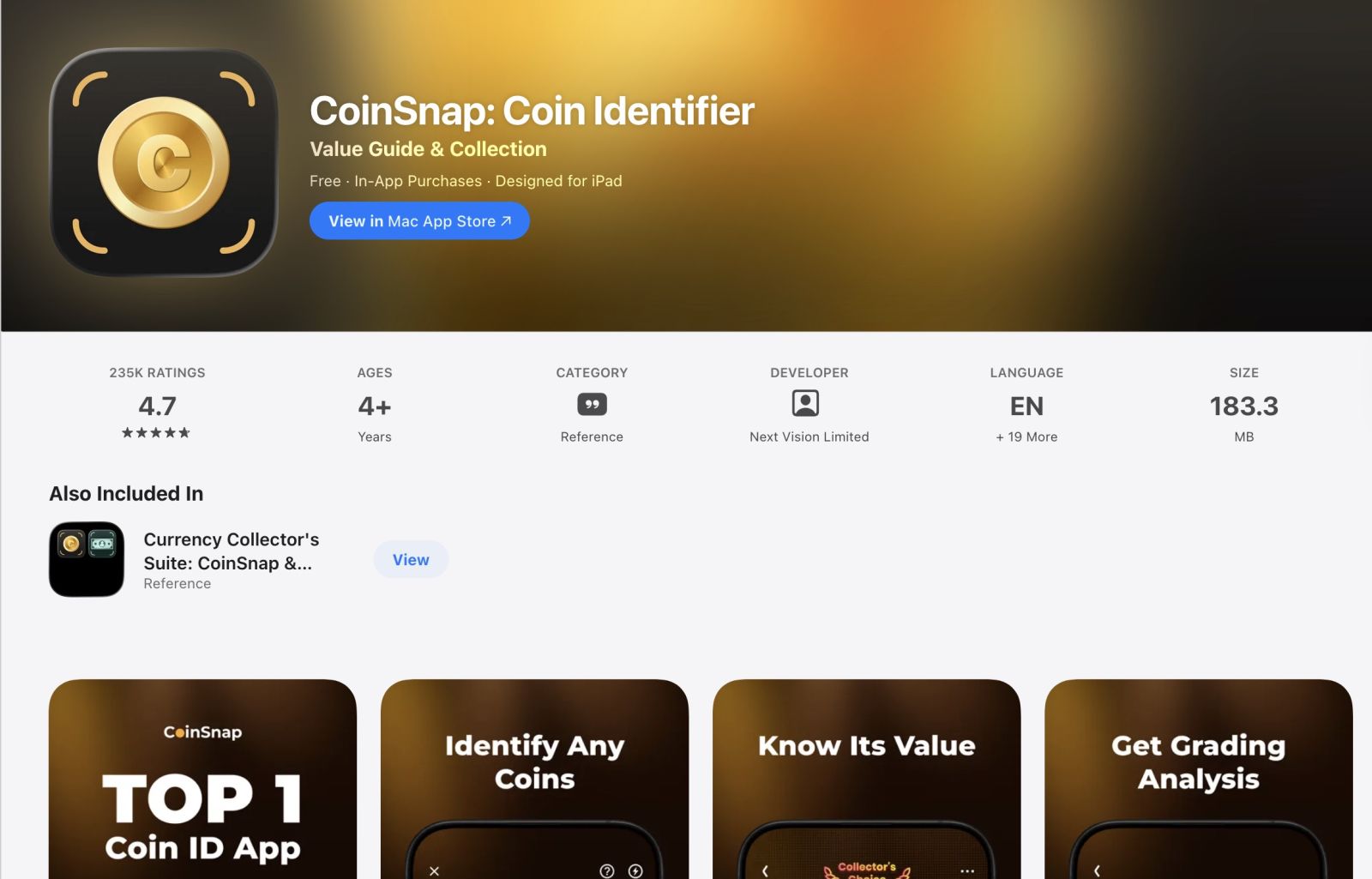
If you haven't heard of Coinsnap before, let me bring you up to speed - it's described as the "TOP 1 Coin ID App" in the Apple App Store. The developer claims: "CoinSnap is a companion for coin enthusiasts. Whether you're identifying a rare error coin, uncovering the value of a hidden gem, or organising a collection of hundreds of coins, CoinSnap makes it fast, easy, and fun to explore the fascinating world of numismatics."
Sounds fantastic in theory, but in reality, it's a little like having a year 10 geography student act as your guide on a trip into the Amazon jungle. They'll be earnest and will have a basic grasp of the knowledge required, but they will be woefully inadequate when the stakes are high.
Next Vision App Suite
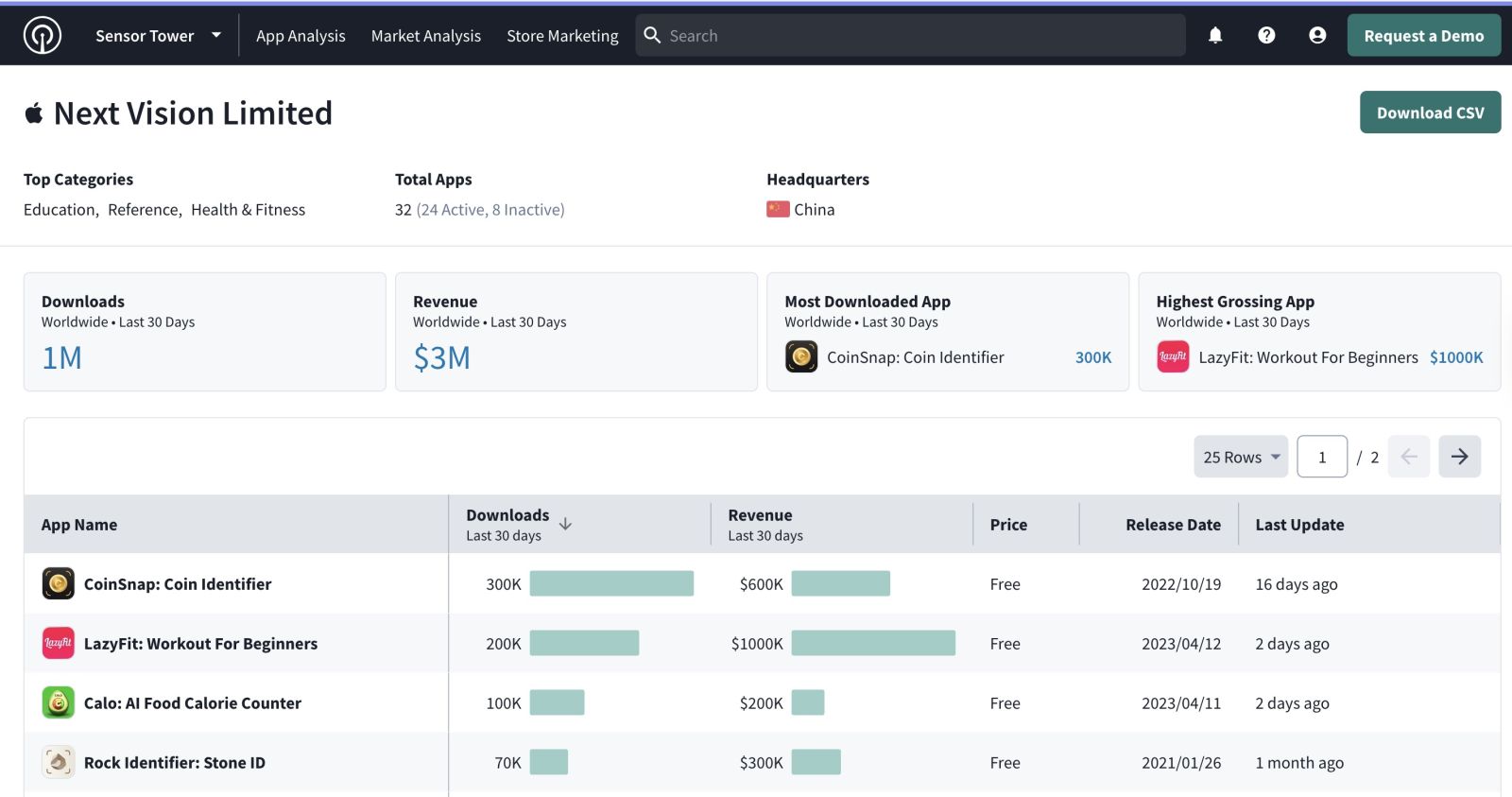
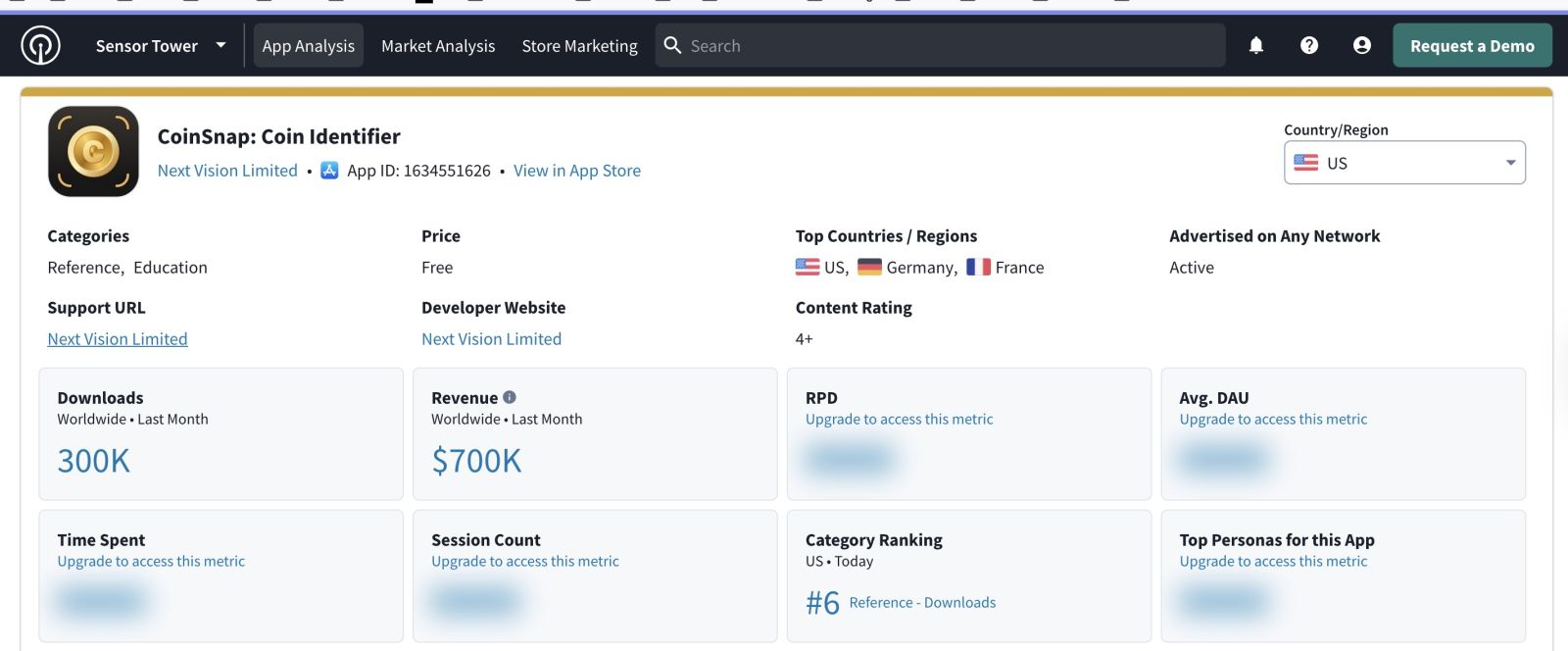
The developer claims to have more than 22 million "users" worldwide, and independent information from Sensor Tower (a platform that provides intelligence on the market for mobile apps) estimates the app generated US$700,000 in income in the past 30 days alone. More than US$8,000,000 a year is big business, so this solution clearly resonates with people right around the world. There's clearly an itch that needs scratching here!
CoinSnap Coin Identification App
The developer behind the app is Next Vision Limited, they're based in China. There's very little publicly available information about them online, but Sensor Tower reports they have a suite of 24 apps that have generated about US$3 million in revenue last month alone.
A few of the other apps in their suite include such useful titles as: "Rock Identifier: Stone ID", "VinylSnap: Scan & Value Record", "Picture Mushroom: Identifier", "StarSnap: Sports Card Scanner" and "Picture Fish - Fish Identifier".
The common technology across CoinSnap, Rock Identifier, Picture Insect, NoteSnap, VinylSnap and others is an image recognition AI tool. The Next Vision platform is built around this central engine as well as a library of millions of images (of coins and apparently rocks and records) that users' images are compared against.
In each app, the user takes a photo, which is immediately sent to a cloud-based server where the AI model processes it. The AI's accuracy in identification (or lack thereof) relies entirely on the training data it has access to, and this is where the app falls short.
I believe the coin apps are being trusted with 4 tasks by those that use them - identification (broad and granular), grading and valuation.
Task 1: Broad Identification - Determining What A Coin Is, In General Terms
The first task is broad identification - finding out what a coin is, in general terms. This isn't the only job people use an app like Coinsnap for, but it is the first task it's asked to do.
If we're talking about Australian users of the app, I think most of us know what a 2-dollar coin is. We know how to tell what year an Australian coin was made and can even have a basic idea about a commemorative coin just by looking at it. Foreign coins are another thing altogether - the letters are in different languages, they have different images on them, and even use different numbering systems, so conceivably that's where an app like CoinSnap can save a lot of time in identifying something that'd otherwise take hours to work out.
Unfortunately, my experience of the accuracy of CoinSnap's system when it comes to foreign coins is much lower than their stated accuracy rate of 99%. I've snapped a Tongan coin and it has said it was Mexican, I've snapped an Iraqi coin and it said it was from Switzerland! On both of those occasions, I could see the AI algorithm had matched the photos I took with images that looked similar in very broad terms, but the identification was completely wrong. An app that fails this basic task doesn't even pass the first test as far as I'm concerned.
I've seen the CoinSnap app develop capability over time (it's pretty neat the way you take 2 photos, it crops out the background and spins them around while it does the data matching in the background), so their image library will no doubt build over time, but it's sure inadequate at the moment.
Task 2: Granular Identification - Determining What A Coin Is, In Specific Terms
There's a quote from Maya Angelou I like: "When someone shows you who they are, believe them the first time." The claim made by Next Vision Limited that they have "300,000+ coin types" in their library is a telling statement, because they would grow their image library of any particular series of coins from a basic coin type (ie a 20 cent coin from Australia) into each of the individual dates and varieties of that series.
This is where an app like this can be particularly dangerous, because it can provide broad information alone, where detailed, granular or really specific information is needed to get an accurate idea of what a coin is and what it is worth.
Let's use the Australian 20 cent coin as our example again. If I upload images of a 1966 Wavy Baseline 20 cent coin in premium condition into CoinSnap, it tells me that the mintage is 58 million and it's worth 54 cents Australian. The sample images I used were for a coin PCGS had graded MS64, so it'd bring around $3,000 in the current market. From a basic image-matching perspective, the app broadly identified the coin really well - it said it was an Australian 20 cent coin and that it was dated 1966. But it doesn't have the specialised database that says the wavy baseline variety of that year is a rarity, so it didn't match the coin I have with the specific identification necessary to get the full value the coin has.
The same thing happened with a rare 1920 penny variety that I entered. The app was able to identify it in broad terms, but it wasn't able to tell that the coin had a small dot above the bottom scroll and was struck with what's called the London or English obverse - details that make it worth thousands of dollars more than the standard coins from the same date.
We can defend the app's lack of ability to identify coins to the same standard as an expert might by saying that kind of knowledge really takes decades to build, but if users are relying on the app to give them a reasonably accurate idea of what their coins are worth, it has to achieve that level of accuracy or it falls seriously short.
Task 3: Grading
The grading capability that the app touts isn't one of the functions users describe in glowing terms, mainly because someone who isn't a numismatist doesn't appreciate just how important determining condition is when setting the value of a coin.
A coin in mint condition is worth exponentially more than one that is in used condition, but being able to tell the two accurately and consistently is beyond the capability of any computer, let alone a free mobile app that comes from China! Professionals with deep expertise in numismatics have thrown a lot of resources at computerised coin grading but they have failed.
This means the person who submits images of a coin in mint condition will get roughly the same values as the person who submits the same coin in used condition. Again, we can defend the app's lack of ability to identify coins to the same standard an expert might by saying that kind of knowledge really takes decades to build, but if users are relying on the app to give them a reasonably accurate idea of what their coins are worth, it has to achieve that level of accuracy, or it falls seriously short.
Task 4: Valuation
Despite CoinSnap being framed rosily as "a companion for coin enthusiasts", this is the reason why I believe 99.99% of people will download it. If they want a companion, they'll buy a Labrador. They download a coin app to get an idea of what their coins are worth! This is where the app really fails because the figures it quotes are nowhere near accurate enough for it to be considered reliable.
A circulated 1966 20-cent coin I snapped was described as 54 cents, which is 34 cents more than what would be possible any day of the week, anywhere. A mint-condition 1922 Melbourne sovereign was described as being worth $1,478, which is around 5% of the actual market value it has. I could go on and on quoting wrong figures, but the result will be the same: the app provides just plainly wrong values, if not outright misinformation.
How can this be? Let's keep in mind that the capabilities this company has are in image recognition and matching, not in the specialised world of numismatics.
There are 3 capabilities a coin app is going to need if it's going to work properly - the AI image recognition and the neural network necessary to match the images submitted with a library of product images, the image library of every single coin type required, and granular market values for every different type of coin in the library.
The good people at Next Vision Limited have one of those capabilities at a pretty high standard, but they are lacking badly with respect to the other two. They've built a business that turns over more than ten million US dollars each year, but they don't have basic numismatic knowledge.
If you're considering getting your coins appraised accurately, who would you ask - a Chinese guy with expertise in image recognition? Someone who's amassed a digital image library or someone with deep knowledge about coins?
The problem we all have in 2025 is that we get what we pay for when it comes to free phone apps and social media content. The allure of the easy solution is sufficiently enticing that apps like this start folks down a rabbit hole of affirmation or verification.
In the coin world, that means someone who's used CoinSnap eventually ends up contacting a coin dealer like me to get an expert's opinion. I now realise that my job is to stay calm and empathetic when asking them if they're confident in the information they've been working with, and then providing them with accurate information on what their items are really worth.
I might see if there is a support group that includes rock enthusiasts, people in the vinyl record game or entomologists, I'm sure we'd all suffer the same challenges in dealing with people who use these apps!

Comments (11)
Incredibly Well Researched
By: Justin Hinh on 8 December 2025Andrew did an incredible job researching CoinSnap and how it operates. But what makes this research go above and beyond is finding more about the company behind the app and how much money it makes. It's crucial to see the incentives behind these types of apps. This info is just not readily available anywhere online. Great work Andrew
Sterling and Currency Response
I appreciate your feedback Justin, the information is publicly-available and gives us some transparency in situations like this. Regards,
"Snap"!...Coinsnap Review
By: Scott Wren on 8 December 2025Well said...the coin dealer/numismatist has spent years perusing the pages of Krause, Renniks, McDonald's and Seaby/Spink to name but a few. The internet definitely sparked a numismatic research revolution; alas, it seems that "good intentions" aside, Andrew has put to bed my questions on the accuracy, and therefore the validity, of these coin identification apps. Thanks for validating my concerns before I downloaded the app to see what all the hype was about!?!
Sterling and Currency Response
It is worth checking out Scott, even if only to see what the hullabaloo is all about.
Coin ID apps - immature
By: Andy Clarke on 7 December 2025Andrew, Thank you for a thoughtful review about realities and short falls on coin ID apps. No doubt there is a need for supporting collectors identify items. Gone are the days of the World Coin Catalog - that set of publications was incredible. If only we could have an easy to use digital version of that!
Sterling and Currency Response
Andy, That's the very database that I believe will be incredibly powerful when matched with image recognition technology. In the meantime, I'll keep my hard copies of the Krause catalogues stacked in our library.
AI is a guess at best
By: Anthony McDonald on 7 December 2025Thanks Andrew, very well said. AI is fine for basics but definitely has a long way to go with the detail. There is no substitute for a human expert and hopefully never will be. Anthony McDonald
Sterling and Currency Response
Anthony, technology is slowly assuming a range of roles in the numismatic industry that used to be filled by humans. We may not get completely replaced but I suspect those of us that don't take advantage of innovations like AI will slowly get left behind. We've seen that happen with the increased adoption of online commerce since COVID, no doubt.
If you don't know where you're going, you'll proba
By: Tony Butz on 7 December 2025Make that a Chinese guide in the Amazon.
Sterling and Currency Response
Realistically, a Chinese person could guide a tour of the Amazon as easily as a local, they just need to develop the specialised knowledge to do so first. Gotta give the good people at Next Vision credit though, they're grown a new market segment that has a great deal of value.