
The Rise and Demise of Coins? Pffft.
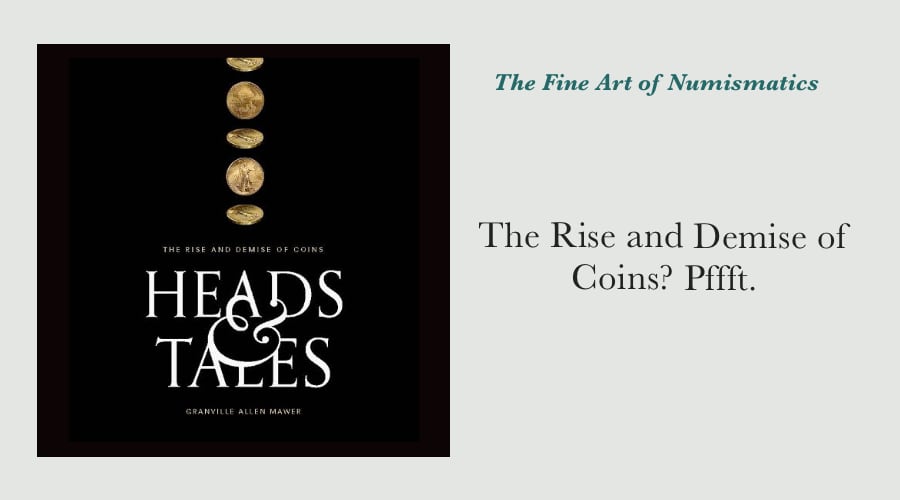
An excellent book on the history of coins was launched in Canberra in August last year. It took me a while to acquire it, but I'm pleased I did. It covers the history of mankind's use of coinage in a focused and insightful way - more than a hundred different coins are highlighted to depict the evolution of coinage.
I was familiar with a number of the coins that were selected; many others were new to me.
As much as I enjoyed reading and (re-reading) about them, I couldn't help but disagree with the book's subtitle, that coins are suffering a complete demise.
To be fair to the author, he doesn't actually state that coins will suffer a complete demise, simply that "It is safe to predict that sometime in our century coins will cease to circulate as currency." After reading that statement, someone who isn't a complete wonk in economic theory might think that if coins won't be used as currency any more, there's no other job for them, so they're irrelevant.
The trouble is, coins (or at least money) serve more than one role - they have more than one job. I have a hypothesis about this - coins are not suffering a complete demise, but the role they're serving is changing. Here's why.
My Hypothesis - Coins Are Not Suffering A Demise, The Role They're Serving Is Changing
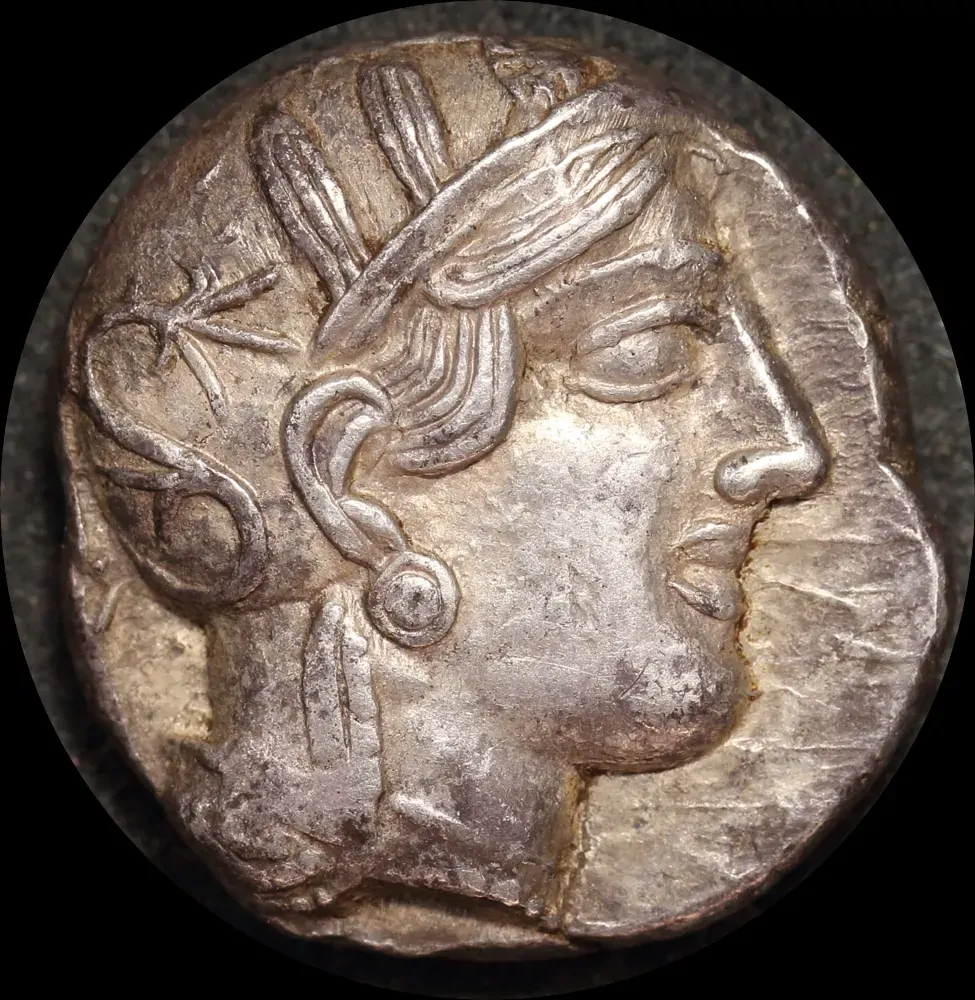
Athenian Tetradrachm
Way back when the Athenian tetradrachm was the world's prime trade coin, Aristotle himself explained that money serves 3 uses:
It acts as a medium of exchange - it "circulates as currency" or is used in day-to-day business;
It acts as a measure of value - it's a common unit that goods and services can be priced in; and
It acts as a store of value - wealth can be held over time in it.
To be fair in this argument that the role of coins is changing, Aristotle didn't explicitly mention coins in his discussion defining the functions of money. That said, he didn't have the luxury of being confused in the distinction between coinage and money, because coins were money at that time.
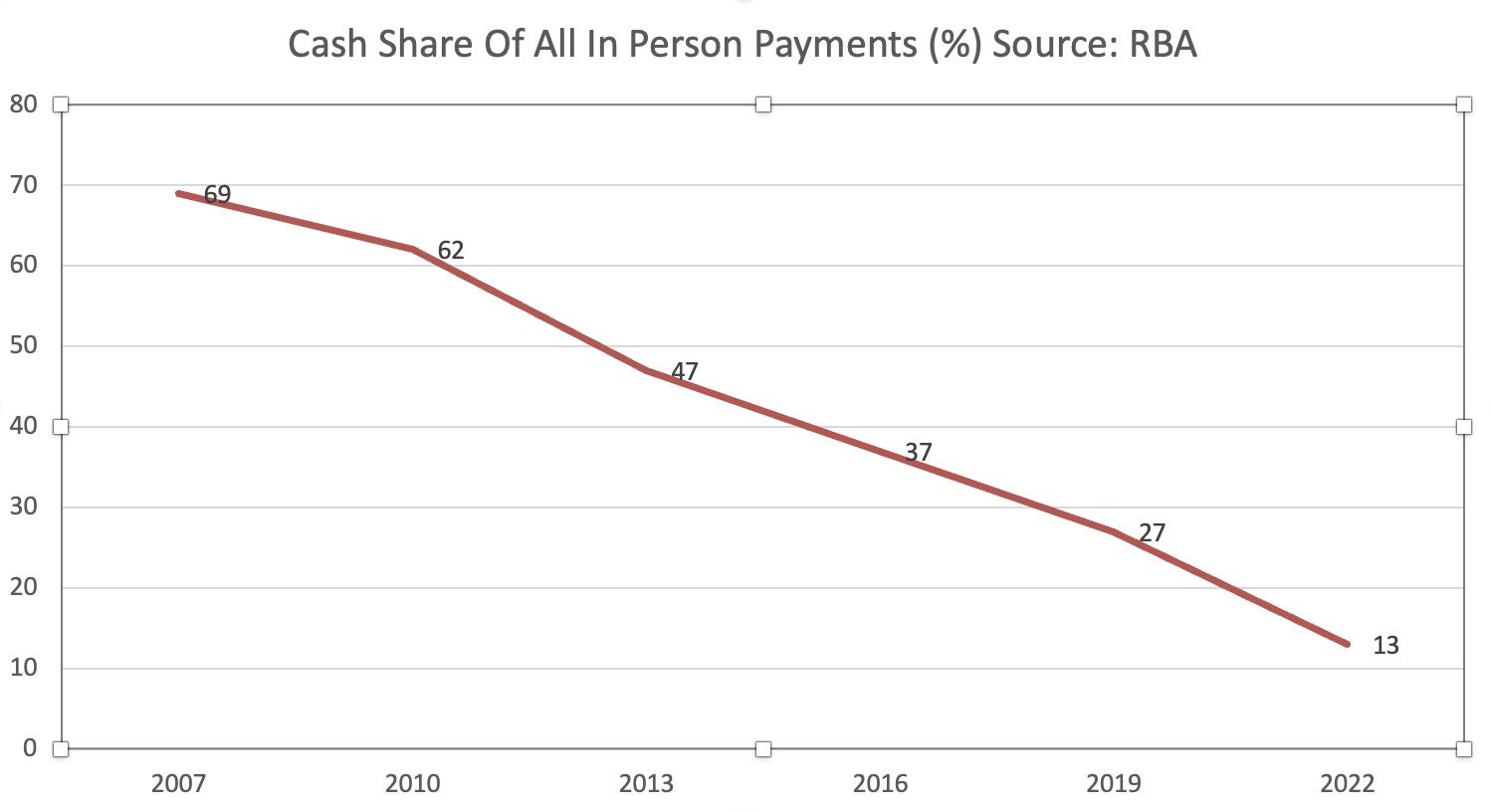
Cash Usage in In-Person Transactions
Locke, Jevons, Smith, Marx or Law all lived in an era where paper currency (and other financial instruments) operated alongside physical coinage as money, and while they debated robustly about which form of money suited which function best, they didn't exclude coins from discussion outright.
The reality of the 21st century is staring us in the face - as a proportion of all payments made for in-person transactions, RBA data is showing that cash has declined from being used in 69% of all transactions in 2007 to just 13% in 2002. 13%! Keep in mind that "cash" is regarded as coins and notes, so this isn't just an indictment on coins, but on notes also.
So even a dogmatic numismatist such as myself has to see this as unequivocal change in the way human beings exchange with each other. In 2026, most of us are quite comfortable regarding money as an abstract concept we see embodied as numbers on a statement rather than as physical objects.
The author of Heads and Tales was clearly moved by statistics such as these to at least write something of an obituary for the main role coins have played for the last several thousand years. The book is described as "... a valedictory survey. It follows the story of coins from conception through substance to shadow. Presenting on average a tale for each generation since the beginning, it celebrates the rise and chronicles the demise of a remarkable invention."
The book has been superbly produced - the reproduction of the images is excellent, the print quality is excellent, and the graphic design is superb also. The text covering each featured coin is evocative enough that I could read a few each night before bed and keep myself educated and entertained for several years.
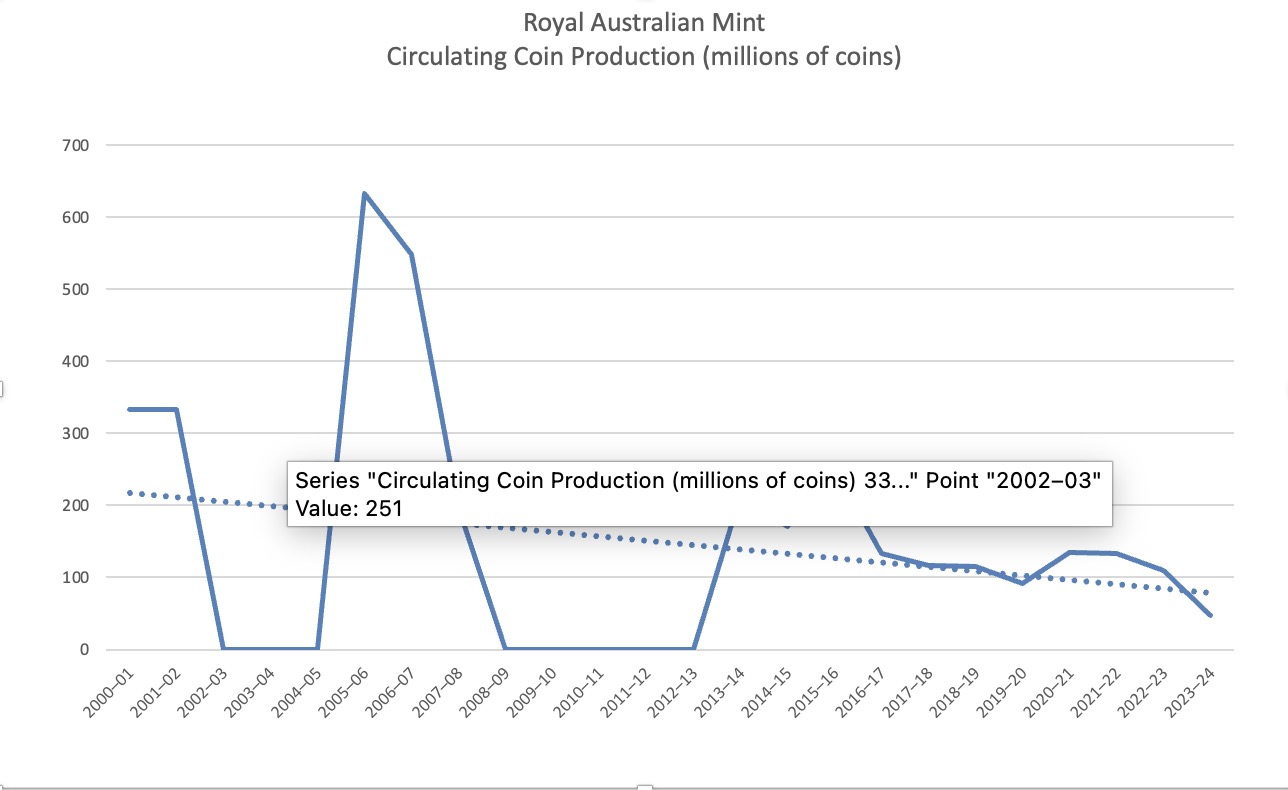
Circulating Coin Production in Australia
My own experience tells me that while cash (and by extension, coins) are being used less and less, there is much evidence they are now being used far more often as a store of value than ever before.
I spent several hours wading through the annual reports of the Royal Australian Mint and came up with two tables of statistics - the number of coins struck for circulation each year and the dollar value of the numismatic items sold by the Royal Australian Mint each year. Put both of them side by side, and we can plainly see why my gut tells me that coins are not going to be suffering a demise any time soon.
As the graphs here show, while the Royal Australian Mint struck 333 million for circulation in 2001 to and just 47 million in 2023 ( a fall of around 86%!), sales of their numismatic products rose from $18.9 million in 2001 to $87.7 million in 2023 (a rise of around 363%!). Looking at the trend line in both of those graphs, we can see they're clearly moving in different directions.
These are of course just two points of data, but I believe they show an underlying trend - at the Royal Australian Mint at least, more coins are being produced for use as a store of value than they are as a medium of exchange. There will be other statistics that could confirm that coins are more often being used as a store of value than they are as a medium of exchange - the % of individuals who identify as coin collectors; as well as the average size and value of those coin collections
What I find intriguing about this is that consumers are driving a reduction in demand for one product, yet are driving an increase in demand for a different product, even though both of those products can be classified as coins!
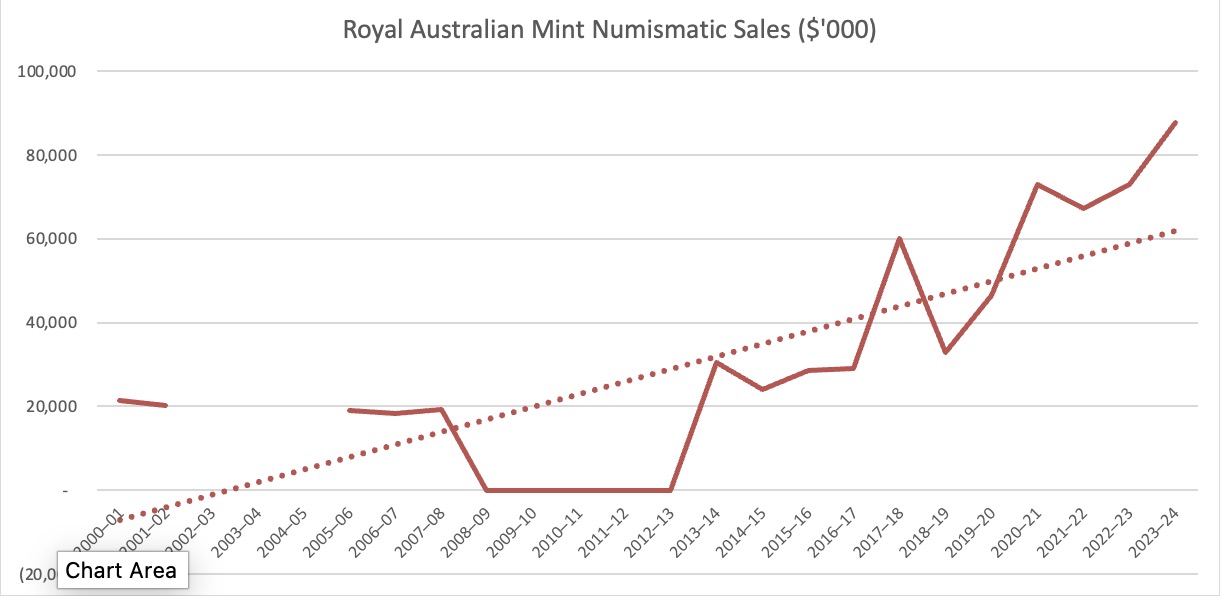
Royal Australian Mint Numismatic Sales
We can see that one form of coin is being called for less and less, while there's an increasing appetite for a different type of coin. To the degree that the staff of the Royal Australian Mint invent and market new coin products that meet that demand, we can expect to see the graph showing numismatic sales to continue to diverge from that showing production of circulating coinage. While the production of circulating coins can only decline so far as zero, I wonder what the limit to the growth in numismatic sales is?

Comments (5)
In agreement
By: Les on 16 March 2026The covid spike seen in the graph (link at bottom) is likely being replicated during this period of "handouts" (quoting former RBA Chairman Lowe). However, the ultra low interest rates of early Covid and the noughties and teens is over. One suspects that notes are now being coverted into tangible assets by a population increasingly aware of decreasing purchasing power of their notes and coins. Noted anecdotally by this dealer in the declining interest in RAM base metal sets. JMO. "Demand for banknotes in Australia has remained strong for many years. Over the decade prior to the COVID-19 pandemic, growth in the value of banknotes in circulation was around 6 per cent annually, outstripping nominal GDP growth. Since the onset of the pandemic, overall demand for banknotes has been extraordinarily high, with the value of banknotes in circulation increasing by around 20 per cent between February 2020 and October 2021. As at October 2021, the total value of Australian banknotes in circulation was $100 billion, double the value in 2010 (Graph 1)." https://www.banknotes.rba.gov.au/resources/banknote-distribution-consultation/issues-paper/the-cash-landscape-in-australia.html
Sterling and Currency Response
Les, When I get more time I'm going to make sure the statistics quoted here are reliable. Some of them were scraped by an AI tool from the information that's been published online, I had to fill in a few gaps by manually checking each annual report. The volume of RAM sales of numismatic products each year is not a complete guide to the demand for tangible coins, but it has to be a good secondary indicator at the very least. Coin usage has declined diametrically opposite to the demand for currency notes, notably higher denominations that people choose to keep rather than spend. Whether holding cash in the form of circulating currency notes or in the form of mass-produced proof coins or sets probably isn't the point, its clear more than a few people are looking to those items for one reason or another.
It’s the story!
By: Ken Heffernan on 15 March 2026I know this book and its thoughtful author, my friend. I love coins and the story of my country. And the story goes on. That is the point. They are a tangible record of time’s passing, myths, reality and imaginings. Enjoy them and be connected to a tale that has a long way to go! Ken
Sterling and Currency Response
Ken, I appreciate your input and expect Allen will be pleased to hear your kind words! Regards,
Coins
By: Robert on 15 March 2026I read your article with interest and am aware of the change in collecting To me, there are two main reasons for the change Firstly, due to inflation people would need to carry around a fist full of money on their person to meet the day to day transactions of living. This is further exacerbated by the government push to use credit cards etc, along with their policy of not allowing payment of accounts by cash. I may be cynical after over 80 years but see this as a means of the government taking control of our finances and in future allocating pensions etc dependant on how we spend our money over a working career, and of course taxation,thus they will have a full record of our wealth Secondly, to compensate they have gone down the track of producing collector coins. To me these are more medals than coins, and although popular at present as it is a new craze, they will not ever be the same as the becoming rarer circulating coinage. In future we will have thousands of collector coins/medals all in pristine condition. There will be no VF, EF or Fine etc to give a varied value of a coin….the only factor will be the mintage I think circulated coins will have a big future
Sterling and Currency Response
Robert, I appreciate your input. I agree that in a less-cash world (as opposed to a cashless world), while many people are happy to make use of virtual forms of money, some at least are interested in balancing that electronic convenience with a range of assets they can see and physically hold.
The Reversal of an Identity.
By: DAVID LOWING on 15 March 2026Andrew the trend that you forecaste is completely correct, we are now seeing Numismatics being on the same level as Art, a collection point, which enthusists indulge. With the value of precious metals rising, the coinage that is sculptured from these ingrediants is becoming more sort after, along with the colourisation of coinage, which enhances the asthectic appeal,that has been evident since 2012 and the advent of the "Red Poppy" two dollar coin. Who would have imagined in 1966 with the conversion of our stirling currency to an decimal one, would see a complete shift in dynamics and as a collector for some seventy years, I couldn't have seen this coming. The shift by the RBA to not only be irrevalent but also to keep our much loved hobby afloat has taken us unawares. My obvious question is, when will we see strong individual currencies, such as the US and European ones follow suit, will we see a coloured silver Morgan dollar or European equivalents??
Sterling and Currency Response
David, I think colorisation is just one of the tools mints around the world are using to ensure their coinage remains of interest to their local populations. I agree that the average collector can only consider and buy what the mints of this world create and market to them, so this trend is being driven by mints that are innovating in order to avoid complete obsolescence. There are numerous private mints in the US that colourise and gold-plate US circulating coins, that may be preventing the Federal government from taking that step.
Interesting Article
By: Steven Watts on 14 March 2026But the level of greed and corruption in the numismatic sphere is growing.l think the mints are shooting their own selves in the foot