
How Can Cash Use Be Up but We've Stopped Making Polymer Notes?
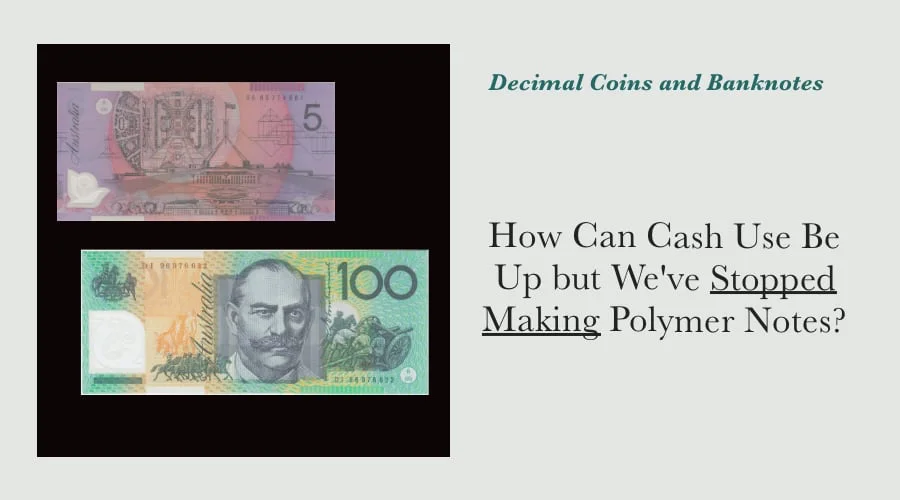
Two news stories broke this week in the sphere of Australian numismatics - I received a forwarded email from Rod Sell, the Membership Secretary of the Australian Numismatic Society (he is also the Treasurer!) regarding an enquiry he made with the Reserve Bank of Australia (RBA) regarding banknote production in recent years.
News Story #1: No Banknotes Were Printed By The RBA In 2024 And 2025
Rod asked the RBA when they would be publishing production figures for 2024 and 2025, and was advised that "No banknotes were printed by the RBA in 2024 and 2025 due to the bank holding sufficient stock. The volume of Australian banknotes printed each year varies depending on the RBA’s needs to issue notes or add to its stocks."
I've compiled production records for Australia's polymer notes going back to 1988, a quick review of that data shows that in that 35 year period we've produced at least some notes each and every single year. Some years saw production of each denomination, while in other years just one denomination was produced.
So it is not hyperbole at all to say it is unprecedented for our nation to go an entire year without producing any banknotes at all. I'm not sure what a superlative is for the adjective "unprecedented" is, but I'm going to say that it is "completely unprecedented" for Australia to go two years without producing any banknotes!
News Story #2: Cash Out Day
The second story that arose in the past week or so was news of "Cash Out Day", an annual initiative from an organisation named "Cash Welcome". Cash Out Day is aimed at focusing attention on the demand for and importance of cash as a payment medium. The event got lots of coverage in mainstream media and in the socials - the organisers were asking members of the general public to head to an ATM and to withdraw as little as $20, the aim being to show that lots of law-abiding citizens still have an interest in making sure that cash is accessible.
Events like this are required because a good number of people in Australia believe that unless our nation's banks and government are challenged, cash will continue to be phased out, to the detriment of society.
There has been a simplistic narrative for some time, not just in Australia, that cash is on the way out and electronic payments are slowly and inexorably becoming the default payment method. Some of the statistics quoted in the discussion around "Cash Out Day" is that:
- Around 15% of transactions are still made in cash;
- Around 50% of Australians use cash in a typical week; and
- Cash use has stabilised, rather than declined.
At first blush, production numbers for Australia's banknotes seem to be a pretty decent proxy for the utility of cash as a payment method. After all, if banknotes aren't being used as often any more, then surely less of them will be printed? The reality is though, that simply isn't the case.
There Were $103.8 Billion in Banknotes in Australia in 2024
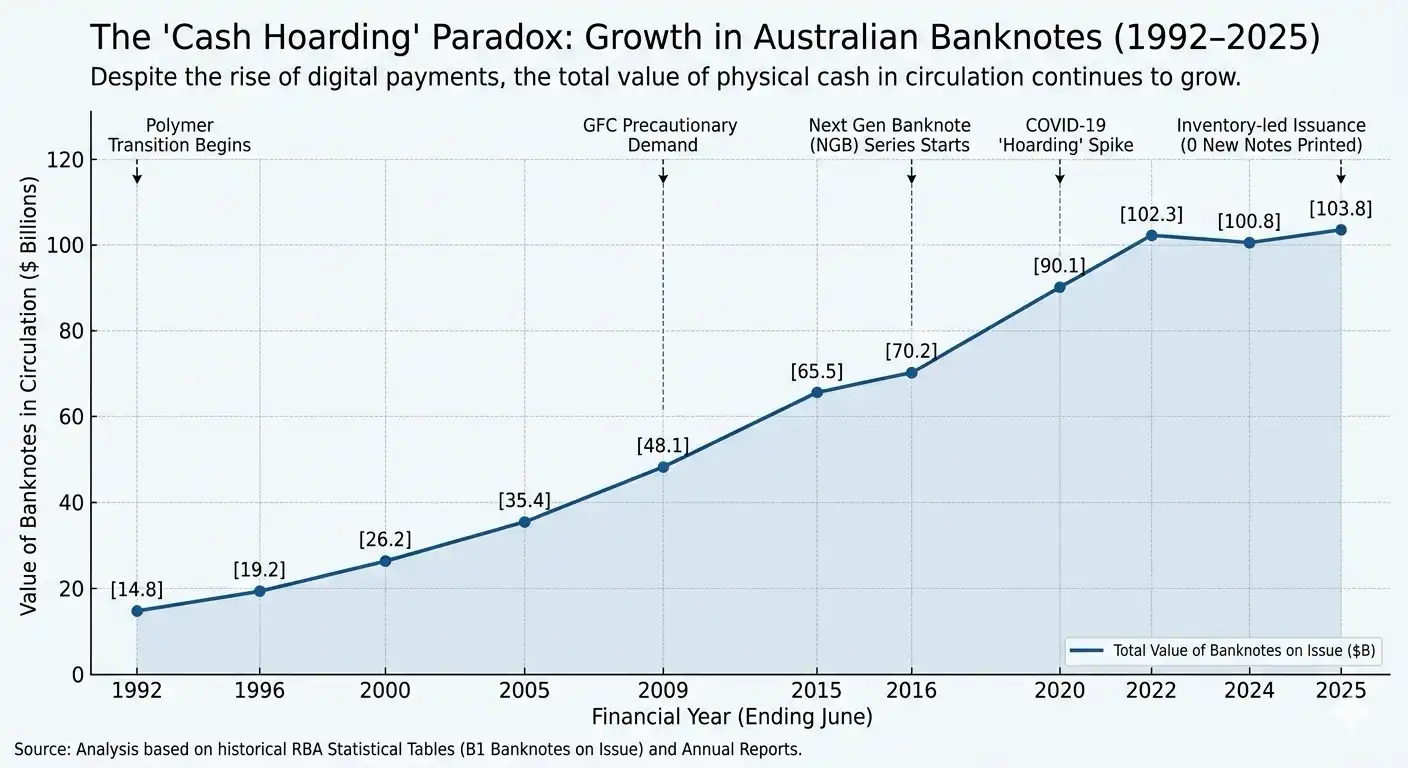
The latest statistics from the Reserve Bank of Australia are that there was $103.8 billion in banknotes on issue in Australia across 2024 and 2025 - that's $13.7 billion and 15% more than was on issue in 2019.
I've pointed out several times in recent months that cash has more than one use - we use it as a medium of exchange (i.e. to pay for stuff) but also as a store of value. Those dual uses explain why cash use can be rising, yet banknote production can enter a temporary hiatus.
The Reserve Bank of Australia's annual report explains how many new notes are issued into circulation each year. Keep in mind that the number of notes issued in any year can be quite different to the number produced in any year. As an example, across FY2024-2025, $5.7 billion in notes were issued, while none were printed. How can that be? Simple - the Reserve Bank of Australia has a stockpile of printed notes that it keeps to distribute as it's needed. In recent years, there have been a number of social and economic reasons why the RBA believes it is prudent to have a stockpile of notes ready to be issued:
"The Pandemic Peak": When COVID began raging across 2020, demand for the $50 and $100 notes surged. People weren't necessarily spending them; they were keeping them at home in readiness if they were needed. I've read stories in the RBA reports from that period of several private individuals who withdrew more than a million dollars in cash for their own purposes. Now, is it crazy for someone to need a milion dollars in cash before they relax? Perhaps, but that was a symptom of just how wound up some people were back then.
Value of Banknotes in Circulation
Data Source: Reserve Bank of Australia
The 2023 Dip: As the pandemic restrictions eased, the amount of cash issued eased to $3.1 billion across 2022/23. This occurred because banks had surplus inventory built up in the preceding years and fewer people were using cash for daily transactions.
NGB Saturation Rate: Between 2016 and 2020, Australia's New Note Series (NNS) or first generation of polymer notes were gradually replaced in production by the Next Generation Banknote (NGB) series. The surge of the inital print runs and the surplus retained in readiness has meant that it has not been necessary for the Reserve Bank of Australia to print any banknotes at all since 2023.
The Shift in Denominations (1992 vs 2025)
| Denomination | 1992 (Millions of Notes) | 2025 (Millions of Notes) | Growth Factor | Primary Use Case (2025) |
|---|---|---|---|---|
| $5 | ~70m | ~220m | 3x | Low-value transactions |
| $10 | ~85m | ~165m | 2x | Low-value transactions |
| $20 | ~145m | ~215m | 1.5x | Declining (replaced by $50s) |
| $50 | ~160m | ~1,050m | 6.5x | ATMs & store of value |
| $100 | ~35m | ~485m | 13.8x | Private store of wealth |
Comparative Trend: $5 For Spending vs $100 Notes For Safe Keeping
The growth of the $100 note is the most dramatic "production" story in Australian currency history. Although the majority of the population will say they rarely see a $100 note in daily life, there are now more than twice as many $100 notes in existence as there are $5 notes.
Since 2020, the NGB series notes are now very nearly the only notes we see in circulation. Because the higher denominations are being kept rather than spent, they last longer than the lower denominations and therefore they do not need to be printed in as large quantities or as frequently.
With all of this in mind, does it still shock you that there are roughly 18 $100 notes for every person in Australia?
Previous Gap Years - Missing Production of Specific Denominations
| Denomination | Significant Gap Years |
|---|---|
| No notes were issued in 2000 due to preparation for the Federation $5 | |
| $5 | No $5 notes were printed in 2004, 2009, or 2014. |
| $10 | No $10 notes were printed between 2000 and 2002, and again in 2004. |
| $20 | No $20 notes were printed in 2001, 2004, 2007, or 2012. |
| $100 | There were no $100 notes printed for almost a decade between 1999 and 2008 because the initial 1996 print run was so large. |
The Rarity of Complete Production Gap
Since 1992, there has been no year prior to 2024/25 where the RBA officially reported zero production across all denominations simultaneously. However, there were two occasions that came remarkably close:
1. The Post-Y2K Lull (2001)
In the lead-up to the year 2000, the RBA printed a massive buffer of cash to handle potential Y2K bank runs. When the world didn't end, banks were left with mountains of $20, $50, and $100 notes. Production of Australian notes in the year 2000 was focused on the Federation $5 and notes for foreign countries. The result was that in 2001, the RBA only printed a small batch of $5 notes (the Federation Commemorative series). If we exclude that special $5 commemorative note, 2001 was the closest Australia came to a total production halt in the modern era.
2. The Global Financial Crisis Aftermath (2012)
Similarly, after the 2008–2009 GFC, the RBA over-produced high-value notes to satisfy "under-the-mattress" hoarding. By 2012, production was at a historic low. While $50s and $100s were printed, production of production of the $5, $10, and $20 notes was completely skipped.
What About During the Paper Decimal Era?
Going back through the paper decimal banknote era, we can see there were a few more close calls of a total absence of banknote production.
1984 to 1988 - The Death of the One and Two Dollar Notes. Production of those denominations stopped completely once the coins were introduced. Rather than leading to a delcine, that actually freed up production of the other denominations.
1981 - The Relocation to Craigieburn. Note Printing operations moved from suburban Fitzroy to the newer high-tech site in Craigieburn. This resulted in a brief scheduled slowdown in production while the new facilities were commissioned.1967 and 1968 - Post-Decimal Saturation. The successful switch to decimal currency was the result of a concerted effort to prepare enough decimal notes to replace the Imperial denominations. That initial production run was so large, no new notes were needed for 18-24 months at least. (Note collectors will immediately recall the relative rarity of the Coombs Randall notes to those with Coombs Wilson signatures.
Why the Paper Era Had No Gaps
Low Durability: Paper notes were relatively fragile when compared to polymer notes. The RBA had to print hundreds of millions of notes every year just to replace those that were tattered beyond use. If production stopped for a single year in that era, the quality of cash in the street would have been noticable.
Absence of Higher Denominations: The $50 note wasn't introduced until 1973, and the $100 wasn't introduced until 1984. Before then, the economy relied solely on $1, $2, $10, and $20 notes. Those higher velocity notes changed hands often, so they wore out faster and required constant replacement printing.
Banknote Production Per Year and Per Denomination
Data like this is rather dry unless we can translate it into information we can use to inform what we collect and what we don't. I feel like the raw data is going to yield some useful information once we get a good look at it.
| 5 | 10 | 20 | 50 | 100 | |
| 1988 | 19,000,000 | ||||
| 1992 | 110,879,880 | ||||
| 1993 | 22,199,960 | 130,792,365 | |||
| 1994 | 17,289,225 | 166,799,800 | |||
| 1995 | 110,279,880 | 30,139,960 | 253,199,720 | ||
| 1996 | 26,999,960 | 6,749,955 | 32,759,960 | 25,079,960 | 113,423,840 |
| 1997 | 45,830,760 | 22,972,455 | 46,279,920 | 97,439,880 | |
| 1998 | 39,479,960 | 65,699,910 | 35,219,960 | 79,599,880 | 17,775,968 |
| 1999 | 162,479,800 | 99,727,872 | |||
| 2000 | |||||
| 2001 | 120,399,840 | ||||
| 2002 | 34,800,000 | 59,849,910 | 103,959,880 | ||
| 2003 | 39,999,960 | 33,412,500 | 10,080,000 | 32,800,000 | |
| 2004 | 56,159,920 | ||||
| 2005 | 83,598,440 | 76,799,920 | 108,179,880 | ||
| 2006 | 70,299,920 | 53,459,910 | 88,399,880 | 110,579,880 | |
| 2007 | 56,799,960 | 65,078,820 | 119,999,880 | 33,160,000 | |
| 2008 | 57,719,920 | 29,452,455 | 119,999,880 | 121,999,840 | 53,913,568 |
| 2009 | 221,263,760 | ||||
| 2010 | 33,639,960 | 67,019,920 | 33,855,936 | ||
| 2011 | 98,199,920 | 34,207,968 | |||
| 2012 | 34,420,000 | 32,458,275 | 43,959,920 | ||
| 2013 | 23,059,960 | 29,789,955 | 33,479,960 | 90,820,440 | 44,463,936 |
| 2014 | 22,909,680 | 110,319,040 | 79,535,872 | ||
| 2015 | 9,715,440 | 23,669,955 | |||
| 2016 | 162,545,040 | 27,093,120 | |||
| 2017 | 242,347,275 | 64,913,568 | |||
| 2018 | 24,896,160 | 501,803,120 | |||
| 2019 | 10,592,046 | 155,668,545 | 8,465,175 | ||
| 2020 | 13,071,348 | 95,355,855 | 306,913,050 | 244,165,230 | |
| 2021 | 42,490,170 | 15,629,535 | 237,466,710 | 65,673,900 | |
| 2022 | 16,265,025 | ||||
| 2023 | 112,907,610 | 65,129,760 | |||
| 2024 | |||||
| 2025 |
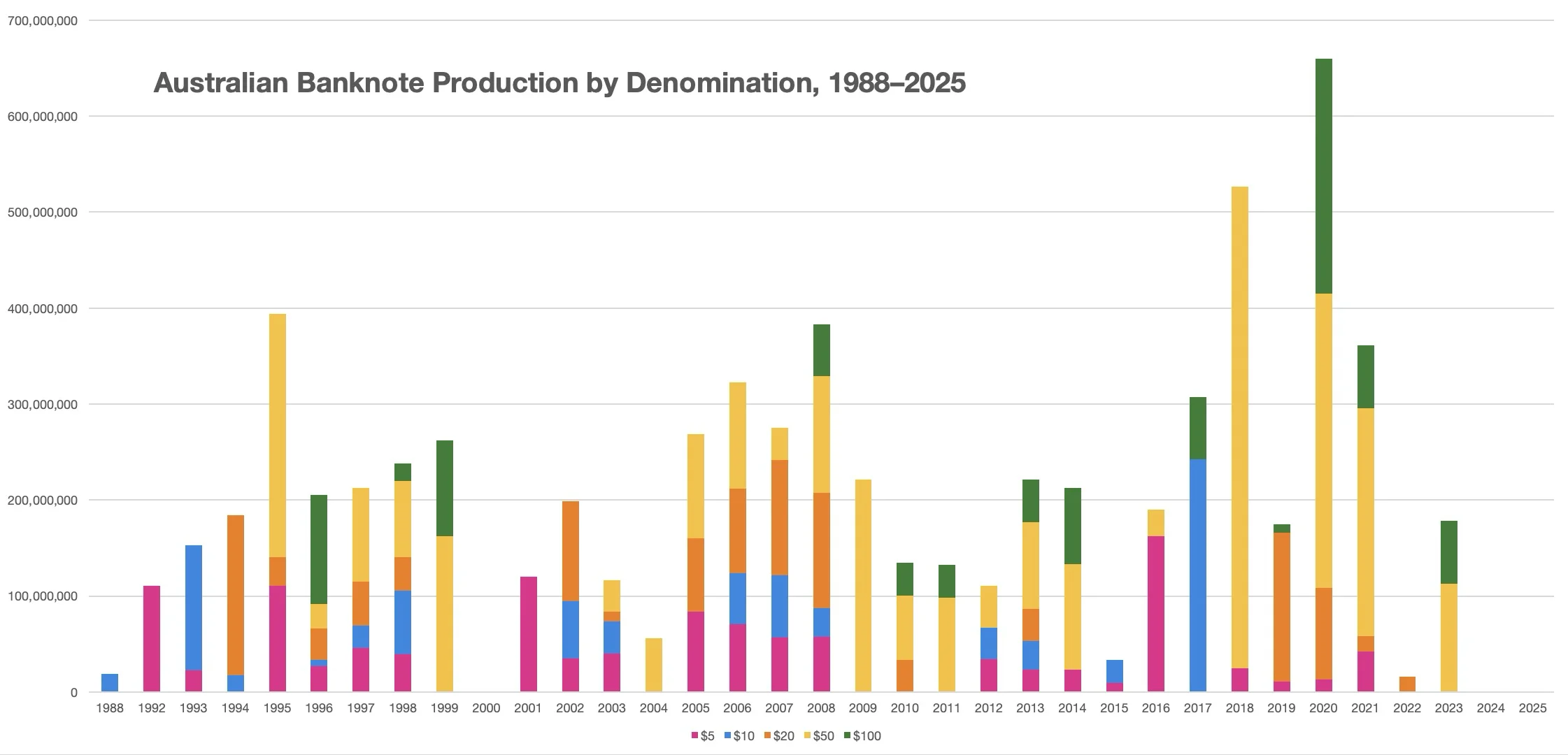
For those of you who prefer to take data in visually, here is the same data in chart format:
Australian Banknote Production Per Year and Per Denomination
So What Can You See Here?
For me, there's a lot of gold across the board (look at 2018 and 2020), so the $50 notes look to be readily available. There's relatively little mauve and blue to be seen, so that gives me a few angles to follow.
First and last prefixes for the $5 and $10 look to be a good way to go at the very least.

Comments (3)
Bank notes.. ,Gold coinage.. and alot..
By: James ilala on 4 May 2026Really appreciated, the updates, I like ..
Another interesting article
By: Dave Darke on 3 May 2026Very good there Andrew, another interesting article on Australia's monetary system that is not always available to the general public, unless one knows where to look. My son-in-law is a builder, formerly living in the mid western suburbs of Sydney, where his clients paid for their building renos in cash, and only cash, not by bank transfer. The cash made him look suspect to the bank that he was on the wrong side of the law, however, he is not. Most of those payments were $100 bills, and some $50 bills. A lot of those people were from non english speaking countries, do not trust banks, and like to deal in cash only. Head to the car dealership and pay cash for a new Mercedes, and not the cheaper models either!
Sterling and Currency Response
There is a widespread narrative that cash payments are always and without exception illegitimately sourced, which is unfortunate and incorrect as you say. The pattern of cash withdrawals during the COVD period put paid to that. Now, whether it's financially optimal to be sitting on a large sum of physical cash (as opposed to having it invested in some other financial instrument) is an open question, but the choice to keep a potion of one's wealth in physical cash might be better seen as a measure of risk avoidance rather than outright criminality!
Cash Isn’t Dead — It’s Just Not Being Spent
By: Scott on 3 May 2026Cash isn’t dying — it’s just changed roles. The RBA hasn’t printed notes because they’ve already got a big stockpile sitting there from the COVID surge, and polymer notes last way longer anyway. Meanwhile, the total value of cash in circulation is actually high — it’s just that $100s are being held, not spent. So no printing doesn’t mean no demand… it just means supply is already ahead of it
Sterling and Currency Response
Scott, I reckon you're 100% spot on!