
Star Replacement Notes in Australia - How to Collect Them
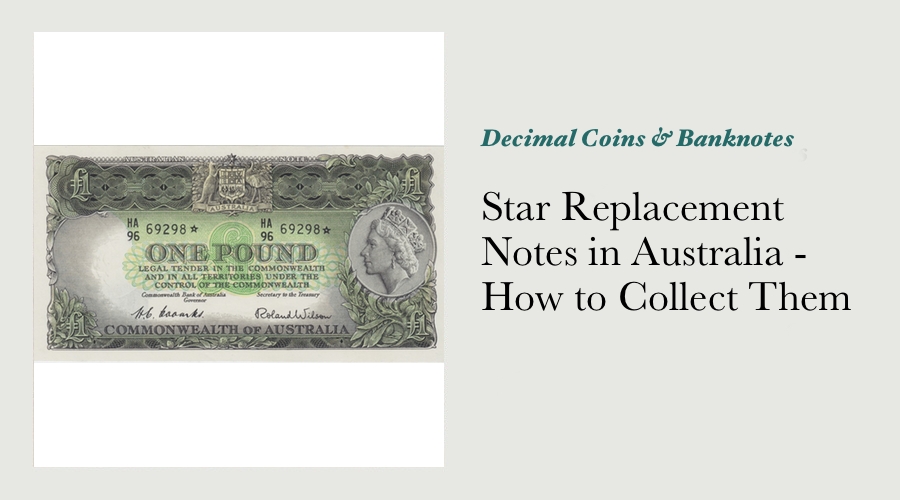
Printing banknotes is just like any other mass manufacturing process, and even though the end product of the banknote production process is rather more celebrated than the average bolt or screw, just like the average bolt-producing machine, banknote printing presses work perfectly 99.99% of the time, but mistakes can and will happen.
Misprinted banknotes are always destroyed immediately (or at least they are as soon as they are spotted), which leave a standard bundle of 100 notes one or two notes short. Checking the serial numbers at the start and end of each bundle is one quick and initial way of telling how many notes are included, so rather than just take a few notes from the next batch to make up the bundle, up until 1948, not only did staff at the Commonwealth Note Printers need to manually identify each mis-printed note and remove it from the series of notes to be issues, they then needed to manually re-number a replacement note.
When we consider that this needed to be done 13, 000 times per week (the equivalent of 100 hours work), we can readily
understand why note printing management were keen to do whatever they could to increase the efficiency of their staff.
Australia Adopted the American Star Replacement System on 10/- and £1 Notes in 1948
In September 1948, Australian note printing authorities decided to adopt the US system of using star replacement notes as substitutes for spoiled notes. A memo to Commonwealth Bank staff at that time advised them that: ""Notes used for replacement purposes will have a five-pointed star in the position normally occupied by the last figure of the serial number.""
The new star replacement system made it much easier for printing staff and tellers to check and count notes, and
brought about a considerable saving in time and labour costs.
Star replacement notes were first introduced into the printing process of Australia's 10/- and £1 notes, but were not used on £5 notes until 1962, and were not used at all on £10 notes. Although we know that all Australian pre-decimal notes are extremely rare, Commonwealth Note Printer records have not yet yielded exact mintage figures for them.
The Scope Of A Complete Set Of Australian Pre-Decimal Star Replacement Notes:
|
Denomination |
Ref # |
Date Range for Usage |
Signatures |
Type |
|
|
Ten Shillings |
R13s |
Sep 48 |
Jan 50 |
Armitage / McFarlane |
|
|
Ten Shillings |
R14s |
Aug 49 |
Apr 52 |
Coombs / Watt |
|
|
Ten Shillings |
R15s |
Mar 52 |
Aug 54 |
Coombs / Wilson |
KGVI |
|
Ten Shillings |
R16s |
Jul 54 |
Aug 61 |
Coombs / Wilson |
QEII Commonwealth |
|
Ten Shillings |
R17s |
Aug 61 |
Apr 66 |
Coombs / Wilson |
QEII Reserve Bank |
|
One Pound |
R30s |
Sep 48 |
Aug 49 |
Armitage / McFarlane |
|
|
One Pound |
R31s |
Jul 49 |
Aug 52 |
Coombs / Watt |
|
|
One Pound |
R32s |
Feb 52 |
Oct 53 |
Coombs / Wilson |
KGVI |
|
One Pound |
R33s |
Oct 53 |
Feb 61 |
Coombs / Wilson |
QEII Commonwealth |
|
One Pound |
R34s |
Jan 61 |
Apr 66 |
Coombs / Wilson |
QEII Reserve Bank |
|
Five Pounds |
R50s |
Oct 60 |
Apr 66 |
Coombs / Wilson |
QEII Reserve Bank |
Australia's Paper Decimal Star Replacement Notes - Much More Is Known
The star replacement system was maintained when Australia switched to decimal currency from February 14th 1966,
however only on the $1 notes through to the $10 notes - they were not initially used in the printing process for $20
notes.
The star replacement system was brought to an end late in 1972, less than a year before the $50 note was introduced in October 1973.
This table shows the scope of a complete set of Australian decimal star replacement notes:
|
Denomination |
Ref # |
Signatures |
Date Range for Usage |
Mintage of Standard Notes |
Mintage of Star Notes |
Ratio of Star to Regular Notes |
Value in Uncirculated Quality |
Price to Rarity Ratio |
|
|
Start |
End |
||||||||
|
$1 |
R71s |
Coombs / Wilson |
14/2/66 |
Feb 68 |
130,210,000 |
535,000 |
243 |
$2,950 |
181.36 |
|
$1 |
R72s |
Coombs / Randall |
Feb 68 |
Nov 69 |
37,690,000 |
172,000 |
219 |
$6,500 |
26.46 |
|
$1 |
R73s |
Phillips / Randall |
Nov 69 |
May 72 |
299,100,000 |
683,000 |
438 |
$2,950 |
231.53 |
|
$2 |
R81s |
Coombs / Wilson |
14/2/66 |
Nov 67 |
192,096,000 |
718,299 |
267 |
$3,950 |
181.85 |
|
$2 |
R82s |
Coombs / Randall |
Nov 67 |
Oct 68 |
75,904,000 |
274,000 |
277 |
$4,950 |
55.35 |
|
$2 |
R83s |
Phillips / Randall |
Oct 68 |
Oct 72 |
473,000,000 |
607,107 |
779 |
$3,750 |
161.90 |
|
$5 |
R202s |
Coombs / Randall |
29/5/67 |
Oct 69 |
57,600,000 |
204,000 |
282 |
$6,500 |
31.38 |
|
$5 |
R203s |
Phillips / Randall |
Oct 69 |
Oct 72 |
84,400,000 |
101,619 |
831 |
$17,500 |
5.81 |
|
$10 |
R301s |
Coombs / Wilson |
14/2/66 |
Oct 67 |
77,168,000 |
336,000 |
230 |
$3,950 |
85.06 |
|
$10 |
R302s |
Coombs / Randall |
Oct 67 |
Oct 68 |
48,132,000 |
167,000 |
288 |
$7,500 |
22.27 |
|
$10 |
R303s |
Phillips / Randall |
Oct 68 |
Nov 72 |
223,700,000 |
348,004 |
643 |
$4,750 |
73.26 |
|
$20 |
R403s |
Phillips / Randall |
Oct 68 |
Oct 72 |
65,800,000 |
62,500 |
1,053 |
$19,500 |
3.21 |
Why Are Collectors Interested in Star Notes?
Collectors have chased star notes for as long as they've been printed, for the same reasons collectors chase anything
- they're
different
and
incredibly rare
. Any collector that looks at a lot of notes will agree that their eye is caught by anything that is unusual and
stands out, star notes fit that bill easily. It's also pretty neat to be able to own something that many other people
have never seen before, or will ever get the chance to own.
What's The Best Way Of Collecting Star Notes?
The easiest way to build a collection of star notes is to get one of each star note issued - decimal and pre-decimal - simple! These notes are so valuable and hard to come by though that most of us need some kind of plan to balance our collecting desires with reality. There are a couple of other ways a collector can add some stars to their collection without breaking the bank.
Just One . No matter what your budget is, no matter what your level of dedication is, any collector can add just one star replacement note to their collection. Just one note can represent the whole series - you don't need a full set to show someone else what they look like, or to explain the role that they played in the banknote printing process. You can make the task as hard or easy as you like, and can choose the rarest or the most readily-available denomination or signature combination, you can get it in heavily circulated condition, or you can get it in crisp original condition. Prices start from just a few hundred dollars for a circulated example, up to many tens of thousands of dollars for the rarest examples in pristine condition. An Uncirculated Phillips Randall $20 will do the job just as easily as a well-used 1961 Coombs Wilson One Pound.
A Type Set
. A
type
set of star replacement notes contains one of each type, and the good thing is you can define the different ""types""
any way you want. You could have one pre-decimal star note and one decimal star note, to cover off both types. Again,
you can choose the rarest or the most readily-available denomination or signature combinations, you can get them in
heavily circulated condition, or you can get them in crisp original condition. Pre-decimal star replacement notes tend
to be more expensive than the cheaper decimal star notes, however the rarer decimal stars can be much tougher to get
than the cheaper pre-decimal stars that were printed a decade or two before. A type set of Australian star replacement
notes shows the history of them over an extended period of time. You could couple a Phillips Randall $1 with a Coombs
Wilson Five Pound to cover both eras off.
A Denomination Set . A denomination set is one that includes one of each denomination that had stars on them - you don't need to get one of each and every single signature combination, just one of each major design type. You can make your job as easy or as hard as you like - you can choose to only include the first signature combination in each denomination, you can restrict your choices to the rarest signatures of each denomination, or you can get the most readily-available signatures for each denomination. A denomination set will include 3 pre-decimal denominations (10/-, £1 and £5), and 5 decimal denominations ($1, $2, $5, $10 and $20).
A Complete Set . The complete set is one that covers everything off - 11 pre-decimal notes and 12 decimal notes. A set like this isn't for the faint hearted, if only for the fact they turn up irregularly, even if quality isn't a consideration. There really is something about setting a target as comprehensive as this - it can be just as exciting as it is foreboding. Once finished, a complete set of star replacement notes shows the full scope of their deployment across the 24 years they were in use. Each different note can elaborate one aspect of the star replacement story to depict the complete history of these rare and compelling notes.
A First and / or A Last Prefix Set . One way of differentiating your collection from others is to focus on the prefixes in the serial numbers on the notes included in it. You could focus only on getting notes that were among the very first printed, or you could get notes that were amongst the very last printed, or you could look to get both first and last prefixes. Very few sets like this have ever been attempted.
A Set of Consecutive Pairs . Another layer of complexity and rarity that can be added to a set of star replacement notes is to only acquire notes that remain in consecutive pairs - two of the same note, numbered one after the other. Although it really isn't unusual at all to get consecutive notes in your change or directly from a bank, very very few star notes remain as pairs or even as trios. Most printing errors occurred on single sheets, and so stars were only ever inserted into bundles one by one, rather than one after the other.
Where Can I Get More Information?
There are a couple of books you can use to learn more about the star replacement note system in Australia - how they were printed, how often they're seen, and what they cost today. Mick Vort-Ronald's books on Australian pre-decimal and decimal notes are required reading, as would be the latest copy of either / or the Renniks or Greg McDonald price guides. These will tell you everything you need to know about Australia's star replacement notes, and how much they'll set you back.
Whichever way you choose to get into collecting star notes, there is sure to be a set and collecting strategy that will suit your budget and temperament. These rare notes are sure to be in demand with collectors for many years to come, now is a great time to get a toe wet and start.
Click here to see a list of the star replacement notes that we have available at the moment , or click here if you'd like to get in touch with Andrew to discuss your own collecting ideas - we'll be pleased to help you each step of the way.
