
Courage and Perseverance: The First Memorial Medal for Captain Cook

A few weeks ago I acquired a modest bronze medal that I've seen at a distance for years but have never handled - the "Courage and Perseverance" medal struck in 1780 to commemorate the life and death of Captain James Cook. Holding it has triggered research that has opened up a new realm of inquiry into Cook's life, his contribution to science and society and the way he is regarded around the world centuries later.

1780 Courage and Perseverance Medal
Struck in copper and slightly smaller than a crown, it’s a modest object and that is the point. Catalogued as BHM 218 in Laurence Brown’s standard reference on British Historical Medals, it is believed to have been struck pretty much as soon as news of Cook’s death reached England.
I know that background information on rarities like this can be as exclusive and hard to find as the items themselves, so I made sure I tracked down the two standard references on Cook medals. Even with those in hand, I still can’t tell you with certainty who made it, or how many were struck - not for lack of trying!
I believe the historical immediacy this medal had when it was issued and the pull that the incomplete knowledge we have of it continues to grant it respect centuries after it was struck.
Why The News Resonated
By 1779, Cook wasn’t just a well-regarded naval officer — he was arguably the most celebrated Englishman of his generation.
His two voyages to the Southern Hemisphere had redrawn the map of the Pacific; he had disproven the theory of the great southern continent; he had circumnavigated New Zealand and charted the east coast of Australia.
He’d been elected a Fellow of the Royal Society and awarded its Copley Medal. He represented, as well as any single figure could, the Enlightenment idea that reason, seamanship and careful observation could master an unknown world. That a man who had survived Antarctic ice and two full circumnavigations of the globe could die in a clash on a beach thousands of miles from anyone who could verify the details, was a genuine shock. In the year-long gap before the official account came out, the public had an insatiable appetite for any scrap of information about what had happened.
A Medal For The Moment
Small commemorative medals reacting to a death or a national event were common commercial products in Georgian Britain. They were quick and relatively cheap to strike, and were snapped up by a public hungry for some tangible way to mark and reflect on the moment, long before a formally commissioned piece was released.
Cook's Death - Nine Thousand Miles From Home
Cook was killed on February 14th in 1779, on the beach at Kaʻawaloa on the shore of Kealakekua Bay, Hawaiʻi, during his third Pacific voyage. While Cook and his men were at Hawaii, there was nothing less than a clash of cultures - Cook's seamen took what they believed to be plain firewood that the Hawaiians in fact regarded as a sculpture sacred to their ancestors and faith.
A ship’s boat was then stolen, which prompted Cook to try to take the Hawaiian chief Kalaniʻōpuʻu hostage as leverage for its return. Cook had used this tactic elsewhere before without serious incident, but this time it clearly went badly wrong. A crowd of several thousand gathered on the beach, and in the scuffle that followed, Cook and four Royal Marines were killed, along with a number of Hawaiians. Cook was 50 years old, and by any measure the most famous navigator alive.
A Year Of Silence, Then A Letter From Siberia
I should not have been amazed to learn while researching this piece just how long it took for news of Cook's death ro reach Britain, nor the route by which the news actually arrived. Cook's crew eventually left Hawaii and headed again for Russia, led by the second in command, Charles Clerke. When they eventually landed at Kamchatka (on Russia's far east coast), Cook's logbook and a cover letter describing Cooks death was entrusted to Magnus von Behm, the local commander. Von Behm ensured it was safely transported across the entire overland expanse of Russia and Europe to London. That journey was around 8,500km, a trek longer than the distance between Perth and Cairns and back.
Von Behm reached the Admiralty on January 10th, 1780, eleven months after Cook died, and a full nine months before his own ships got home. Newspapers had the story in print within a day or two, and news spread across Europe from there. The Resolution and Discovery themselves didn’t drop anchor off the mouth of the Thames river until October 4th, 1780. For the better part of a year, everything Britain knew about Cook’s death came from a single overland dispatch and the rumours it generated, not from any of the men who had actually been there.
What The Medal Actually Is
For collectors into the specifics of medallions - this medal has the reference number BHM 218, it is struck in copper, is 38.00mm in diameter, 2.95mm thick, and weighs around 20grams. The obverse carries a three-quarter-right bust of Cook in naval dress with the legend CAPT. JAMES COOK. The reverse reads COURAGE AND PERSEVERANCE over BORN 1728 · DIED 1779, framed by a simple border with a small floral ornament. It’s a world away from the refined, Latin-legended medal the Royal Society commissioned from Lewis Pingo four years later. This is every-day, commercial work, and is all the more appealing for it.
Why So Much Is Still Unknown
Here are the details that drive me to want to spend the next few weeks looking into this fulltime. Neither Brown’s catalogue of British Historical Medals, nor Allan Klenman’s "Faces of Captain Cook" nor Bill Mira's "James Cook, His Coins & Medals", the standard references on Cook's medals record who actually designed it, cut the dies or struck it.
It turns out this level of dissatisfaction is not unusual when studying medals like this - they were commercial, opportunistic pieces, not state commissions, clearly nobody at the time thought to record the die-sinker’s name for posterity. If we are to make any progress in tracing it back, I believe the only real evidence left lies on the medal itself — the font and punches used for the letters in the legend; the style of the portrait; the size and composition of the planchet.
In my hubris as a numismatist on the other side of the globe alive several hundred years after it was struck, I believe that matching those characteristics with other medals struck in the same era could lead to a logical conclusion we could have confidence in. Not a necessary conclusion for us to appreciate the value the medal has, but one that builds out the story behind it.
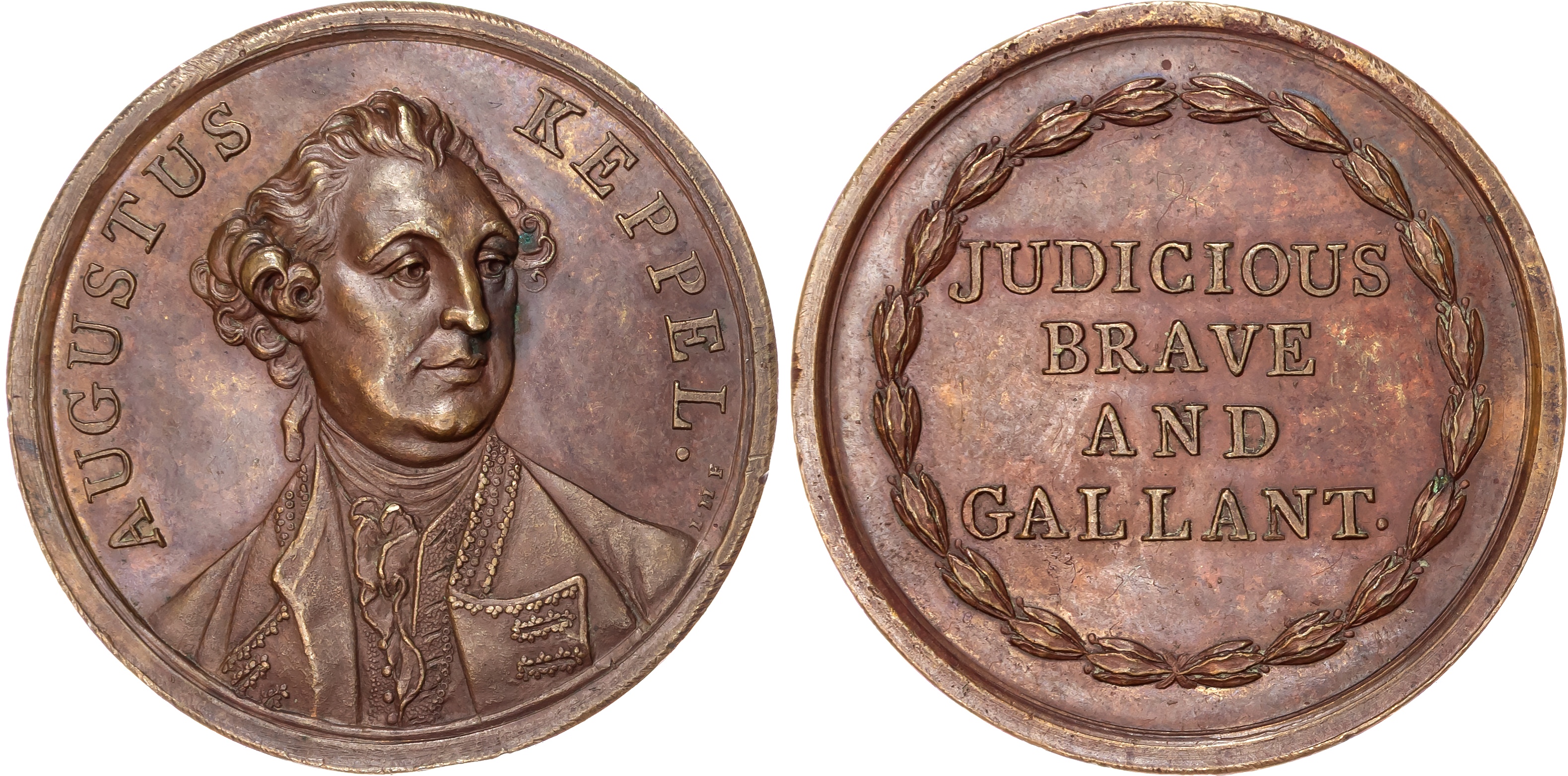
Admiral Augustus Keppel, the Battle of Ushant 1778, AE medal 1778, signed IH.
Image Source: Stanley Gibbons Baldwins
In the short time I've spent on this so far, when I compare the style of the portrait on the Courage and Perseverance medal to that of Admiral Keppel struck a year earlier (BHM 214), I can see a number of similarities. The way in which both faces are cut is genuinely striking — the same drilled-pupil eye, the same rounded nose tip, the same fuller lower lip. That medal carries the cryptic initials “I.H.” on the obverse, but “I.H.” himself remains unidentified in the references I've examined. I don't yet know if that is a common style or one particular to a specific engraver or die-sinker from this period, nor have I been able to identify other copper memorial medals from this era from a specific maker that have the same composition and technical characteristics. This can however be a live line of research, not an outright dead end.
Cook’s Gravitas and Appeal, Then and Now
Cook’s appeal in 1780 was straightforward: he was a self-made Yorkshire farm boy who had become the era’s great scientific navigator, and his death was read as a genuine national tragedy. That appeal hasn’t dissipated down the years, but as indigenous perspectives have been acknowledged, it has become more complicated.
Cook clearly remains a towering figure in the history of navigation, cartography and Pacific science, but as his voyages also opened the door to colonisation, communities across the Pacific and in Australia and New Zealand hold a very different and I believe entirely legitimate, memory of what followed his arrival. Serious interest in Cook today tends to hold both of those truths at once, that tension is what keeps Cook's life as such a enduring subject rather than a settled one.
Collecting Cook, And Why Medals In Particular
The respect for Cook has generated an enormous, two-and-a-half-century body of material objects - printed accounts of his voyages, engravings, Wedgwood and other memorial ceramics as well as medals in gold, silver, bronze and base metal. These objects span the time from 1772 right through to today’s commemorative issues.
Medals hold a particular appeal within this corpus. They’re durable, portable, and were made to be handled. The Courage and Perseverance medal was a coin-sized object someone in 1780 could actually hold while reflecting on a man who’d died on the far side of the world. They also survive in enough variety, across enough decades, to let a collector build a genuine narrative: the 1772 Resolution and Adventure medals; this 1780 memorial piece; the formal 1784 Royal Society medal, right through to twentieth-century commemoratives. For this medal, there’s the added pull of the puzzle itself, it is an object we can hold in our hand while the historical record stays frustratingly, tantalisingly incomplete.
Which is where this particular medal sits - it is not a grand official memorial, not a voyage relic, but something closer to a first draft of history. Struck by someone whose name we may never know, in the raw, uncertain months when Britain knew only that Cook was dead, and almost nothing else.
