
When Competition Was Our Security: What Australia's Free Banking Era Means for Collectors

In May 1893, at the height of the worst banking crisis Australia has ever experienced, the Victorian government ordered every bank in the colony to close its doors for five days. It was meant to calm the panic. Two banks — the Bank of Australasia and the Union Bank — flatly refused. They threw their doors open on the Monday morning, met every withdrawal, and the crowds on Collins Street gradually went home. The banks that obeyed the government and closed lost the public's confidence with their doors — none could simply resume trading, and each had to suspend and formally reconstruct before reopening weeks or months later.
That single morning captures something remarkable about Australia's monetary history, and it's a story every serious collector of our early banknotes is already holding in their hands — whether they know it or not.
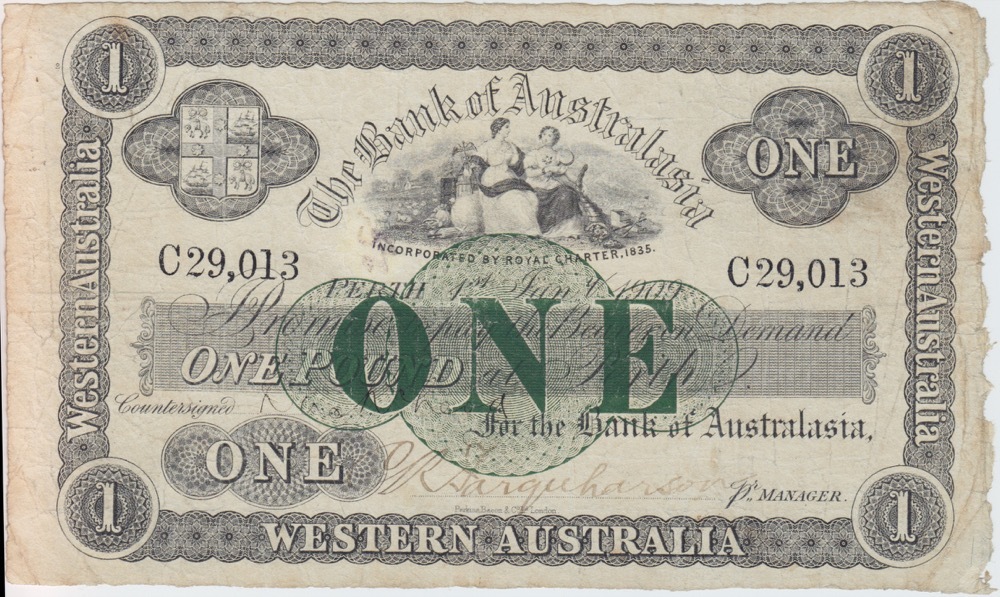
Bank of Australasia (Perth) 1909 1 Pound Issued Note MVR# 2c VF
Australia Had The Freest Banking System On Record
For close to a century — from the founding of the Bank of New South Wales in 1817 until well into the 1900s — Australia ran what economic historians call a "free banking" system. Private trading banks issued their own notes, set their own rates, opened branches wherever they judged there was business to be won, and competed fiercely for every deposit. There was no central bank; the Reserve Bank of Australia would not exist until 1959. In his study of the period, the economist Kevin Dowd describes the Australian legal framework as "perhaps the least restrictive of any on record" — banking here was freer even than in the celebrated Scottish and Canadian systems.
And it worked. By the 1880s, Victoria had one bank branch for every 2,760 colonists — against one per 12,000 people in England. Interest rates were about half as volatile as those in Britain or America. The banks' notes were accepted across colonies, cleared efficiently between rivals, and held their value. Attempts by the banks to form price-fixing cartels collapsed again and again, because there was always a competitor — often the Bank of New South Wales — willing to break ranks for the business. Competition, not regulation, was what kept the system honest.
The Crash Of 1893 — And What Actually Happened
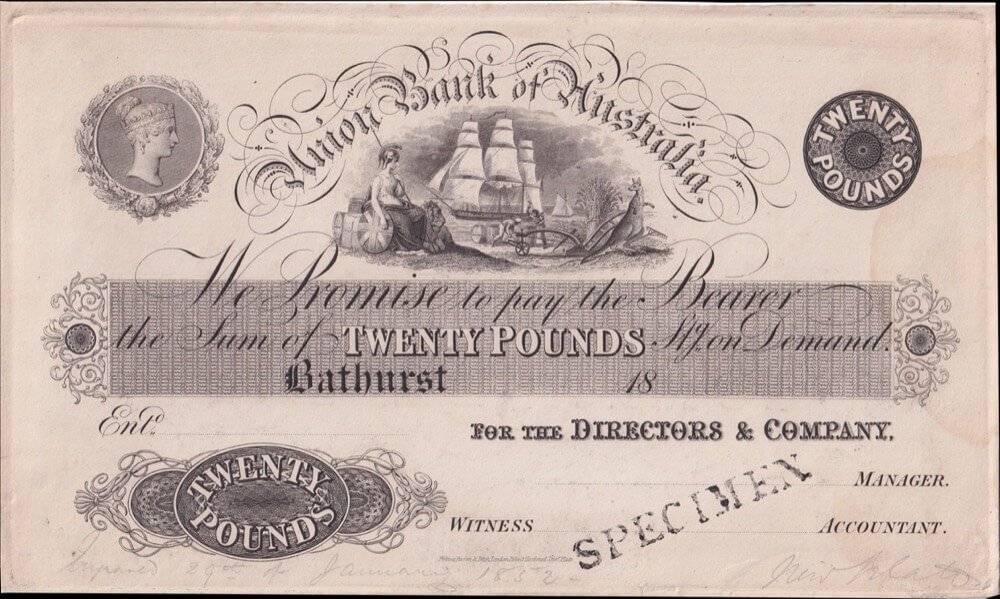
Union Bank of Australasia 1852 20 Pound Printer's Proof VF
The era's great test came in the 1890s. A spectacular Melbourne land boom collapsed, British capital dried up, and the economy fell into a depression deeper than the 1930s. In April and May of 1893, thirteen banks suspended payment.
The conventional story — the one taught for generations — is that unregulated banks lent recklessly and brought the house down, proving that banking cannot be left to the market. Some historians still hold that view, and it deserves to be acknowledged. But the closer look taken by Dowd and others tells a more interesting story.
Depositors in 1893 did not flee the banking system. They fled weak banks for strong ones. The big three — the Bank of New South Wales, the Union, and the Australasia — were never in danger; deposits poured into them so quickly during the panic that their managers were almost embarrassed by it. Nearly every "failed" bank reconstructed and reopened within months, and depositors were, in time, repaid. The most conservative banks — the ones that had publicly refused to join the land speculation in 1888 — emerged with their reputations enhanced. Meanwhile, it was government interventions, including that Victorian bank holiday, that repeatedly made the panic worse.
Depositors, in other words, behaved exactly like discerning investors. With no government guarantee standing behind any bank, they had every reason to judge quality for themselves — and they judged well. Security came not from a safety net, but from the strength and reputation that competition had forced the best banks to build.
Why This Matters Beyond The History Books
There is a reason the Reserve Bank still publishes research on the 1890s, most recently in 2021. The episode remains one of the richest case studies we have in how depositors, banks and governments behave under pressure.
For the personal investor, the lessons travel well. The depositors of 1893 prospered by holding their money with institutions of demonstrated quality rather than chasing the highest rate on offer — the land banks paying 1–2 per cent above market were precisely the ones that vanished.
And the era's end carries its own lesson: in 1910 the Commonwealth taxed private banknotes out of existence; from 1915 the government simply stopped redeeming its notes in gold, even though the promise remained printed on them; and after a brief return to gold in the late 1920s, the link was severed for good in 1929, when the Commonwealth Bank Act of December that year gave the government control over gold exports and the power to requisition gold — marking Australia's effective departure from the gold standard, even though notes acknowledging redemption in gold circulated for some years afterwards.
The pound that followed spent the rest of its life losing purchasing power. Monetary regimes change, usually by government decision and rarely with much notice.
Assets that stand outside any single regime — gold, tangible property, and yes, the artifacts of vanished monetary systems — have a logic to them that this history makes plain.
Collecting The Free Banking Era
Here is where the story becomes something you can hold. The free banking era left behind a body of collectible material that traces the entire arc — competition, crisis, and the arrival of the government monopoly.
Private trading bank notes (1817–1910). The notes of the issuing banks themselves are the foundation of any collection on this theme. A pairing tells the story better than any single note: an issue from one of the rock-solid banks that stood open through 1893 — the Bank of New South Wales, the Union Bank, the Bank of Australasia — alongside an issue from a bank that suspended, such as the Commercial Bank of Australia, or one that failed outright, like the Bank of Van Diemen's Land in 1891. Survivor and casualty, side by side: competition's judgement, rendered in paper.
The crisis issues (1893). The Queensland government's treasury notes of 1893 mark the first colonial government issue displacing private notes — the earliest paper evidence of the state stepping into the banks' territory, born directly of the crisis.
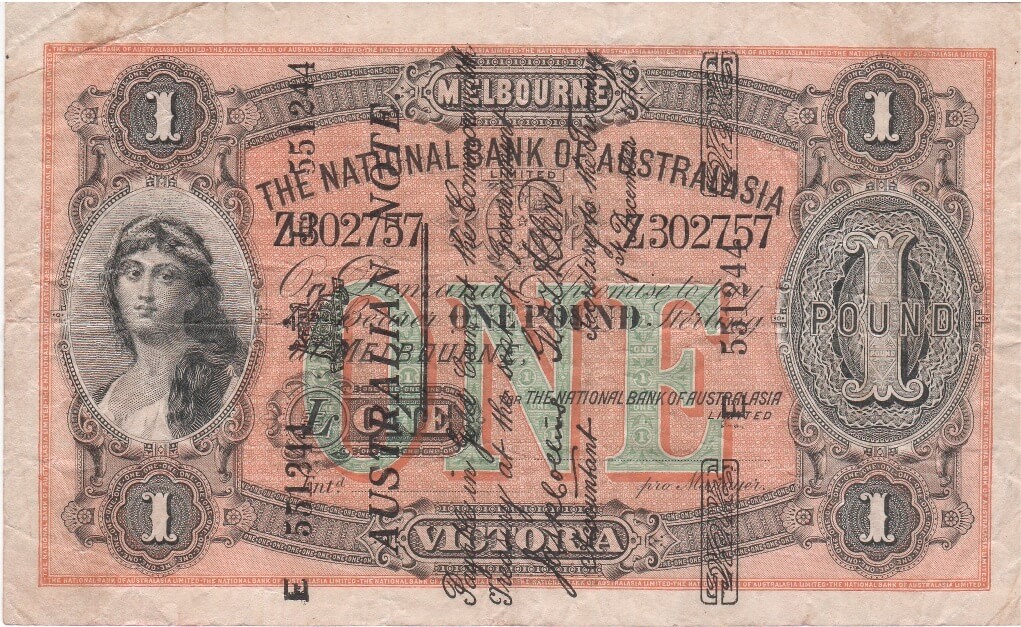
1910 Superscribed £1 Note National Bank of Australasia about VF
Superscribed notes (1910–1914). When the Commonwealth took its monopoly, it bought up private bank stock and overprinted the notes as "Australian Notes." These transitional issues are literally the free banking era being stamped out — the old order and the new on a single piece of paper. Denominations above £10 are now vanishingly rare, and the series stands as one of the most historically significant in Australian numismatics.
Gold sovereigns of the branch mints. The Sydney (1855), Melbourne and Perth mints anchored the Australian pound to gold throughout the era — the discipline that underpinned the whole competitive system. A sovereign from each branch mint makes a natural companion to the paper.
First Commonwealth issues (1913 onward). The ten shillings and one pound notes of 1913 complete the arc: the monopoly currency that replaced a century of competition.
A collection built along these lines is more than an accumulation of rare paper. It is a physical argument — evidence of a period when Australians trusted competing private institutions with their money, when the strongest of those institutions proved worthy of it in the worst of times, and when the change to government money came not because the old system had failed its users, but because the government wanted the revenue.
Australians have a clear history of competition being the path to security. The notes are still here to prove it.
For a detailed survey of the notes themselves, see our companion piece on Australia's pre-Federation banknotes. The historical account above draws on Kevin Dowd's chapter "Free Banking in Australia" in The Experience of Free Banking (Institute of Economic Affairs); readers wanting the other side of the debate can start with Hickson and Turner's "Free Banking Gone Awry" (Financial History Review, 2002).
